author's note: It isn't done, but I'm putting it up for you, Jackie.
2nd author's note: I screwed up the HTML markup on the footnotes and I can't fix it. I'm stupid and pudgy :(
Between the 9th anniversary of 9/9/99 (wherein our protagonists Bernie Stolar and Peter Moore launched their quixotic campaign to restore Sega's good name among the general US public before the company's 6+ year streak of bonerheadedness caught up with it); Sega's late-to-the-party stateside release of one of 2006's best PS2 games, Yakuza 2
[1]; and this amazing
amazing (if slightly old by internet standards) look
at Segagaga from Edge Online, I've got Sega on the brain.
I love Sega in the way I'd love a brilliant, slightly crazy, charismatic uncle who spends part of his life painting beautiful watercolor tapestries, and the other part of his life shooting heroin into the veins on his feet. A few years pass, you don't really think about him until you hear from your second cousin that his Grandpa is cleaning up his life and kicking the horse. You ask him, "Oh, is he in NA or another support group?" and your second cousin replies: "No, he just got bought up by Sammy. He won't pull me teeth for drug money any longer, but he also won't stop drawing all these really awful pictures of Sonic with his shitty friends."
And, if Sega was that uncle I just made up, he'd have plenty of things to apologize for, were he ever to join AA and reach the 7th step.
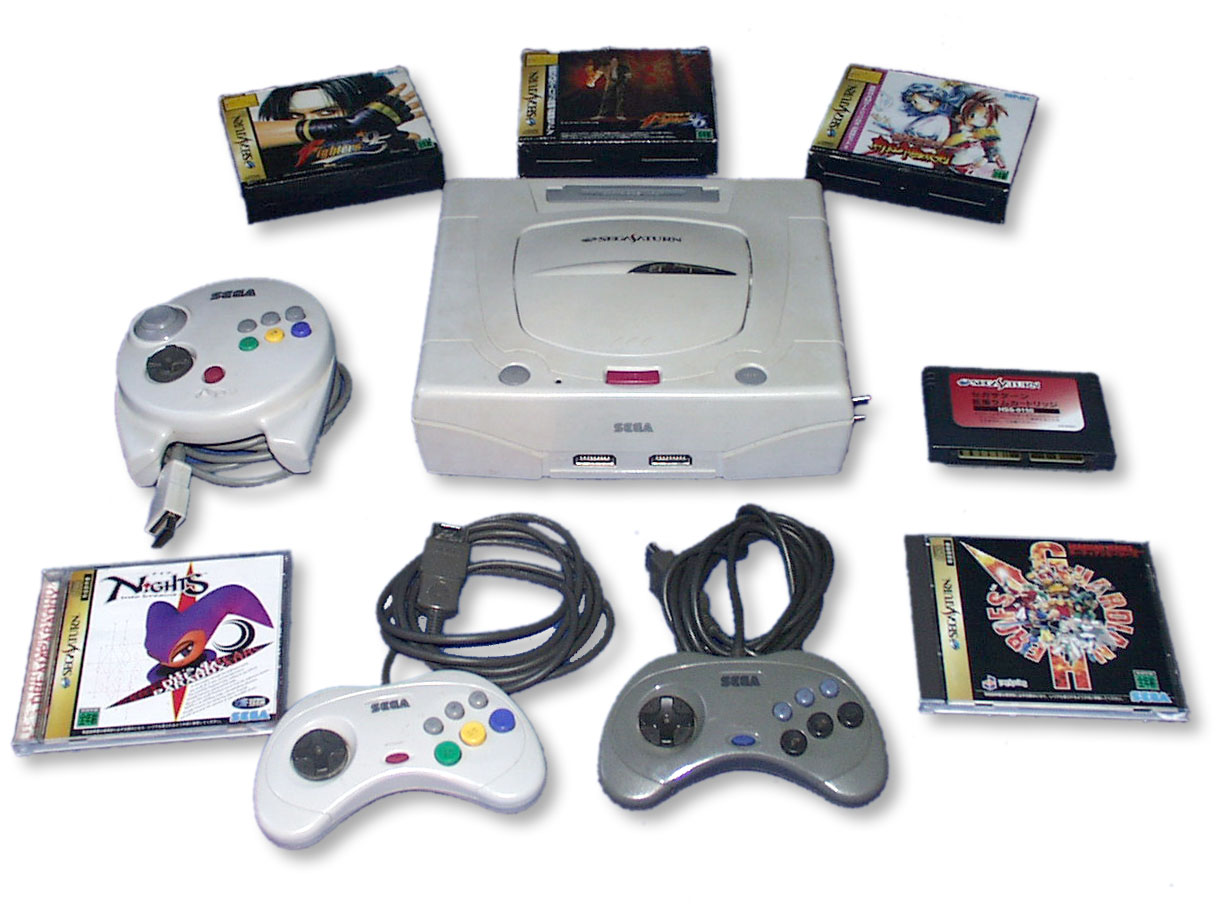
There was inexplicable stuff like the 32x. There was the inexcusable stuff like launching the Saturn the day before E3 1995 under the assumption the PSOne was going to launch at a similar price point (Sega's New Sku was over $100 dollars more, in '95 monies, and who wanted to pay $400 to play a janky Virtua Fighter?). There was the uncannily awful and superfluous stuff, like the very existence of the US Saturn pad. There was that horrendous Virtua Fighter port at launch - a port so bad the 32X was the platform to own for console VF play. Weird parallel: the Dreamcast's most disappointing launch title was also a Virtua Fighter, the 3rd one, a port that Genki had 5 months to program without retail dev kits. There was Three Dirty Dwarves -- oh, God, Three Dirty Dwarves. There was the hassle of buying all the worthwhile Saturn software from DieHard GameFan magazine if you were importing stuff like that back in the day
[2]. Games like:
Radiant Silvergun; Sakura Taisen; Baroque; DonPachi and DoDonPachi; Lunacy; Liquid Kids; Darius II; SteamGear Mash.
Worst of all, there was the quick, awful death of the Dreamcast.
However, in spite of it all, it must be said: from 1996-2000, Sega's various internal development houses produced more innovative, influential, quirky, and otherwise important ideas for what games can be than any other first party publisher. Right before SEGA went supernova and discovered what happens on the other side of a black hole (you become a pretty awful 3rd party publisher beholden to paccincho mavens Sammy, it turns out) they shone as bright as imaginable. Why, in the history of all first party publishers, that 1996-2000 Sega run may have had the best run, ever!
"Hrmpf!", you say, "what about beloved Nintendo?" My counter-argument is this: Nintendo's greatest run was 1985-1991, when they had a complete monopoly on the videogame market. Despite making so many epochal, titanic breakthroughs in, well, everything, Nintendo had, like, broken federal anti-trust laws and were kind of evil, forcing their licensees to release no more than 5 games a year, for which these third parties deposited huge, non-refundable monies on their "Game Pak" orders. When would these extremely expensive products reach consumer's hands? Well, it would kinda depend on when and how Nintedo felt like paying their ship captain to lug the things across the Pacific. So, imagine you're a third party publisher, publishing in America. Your company is named Qix Panic! You've been subjected to months-long waits between ordering anew second run of, I don't know, Qix, and discovering, three months later, a stack of Qix in Wal*Greens. Sadly, you see these wonderful stacks of your game two months too late; your publishing company folded; the up-front costs to produce these Game Paks were so exorbitant, so high and nonrefundable, and with no income from Qix sales in the last few months, your third party publisher had to fold up shop.
You later go on to invent Gals Panic!, so it's not all bad. But if you publish Gals Panic! for the NES, you better DAMN sure not publish it for any other competing videogame system.
Admittedly, the above is only loosely anecdotal (by which I mean, it's entirely made up), but I have been led to understand Nintendo's draconian policies and heartless money grubbing really damaged a lot of great companies. Vic Tokai sunk because of these shenanigans. Vic Tokai made
Clash at Demon Head. To kill Vic Tokai, creators of one of the most awesome games ever, is as morally repugnant as sitting on a kitten until it suffocates and dies.
Nintendo then went on to do what all Japanese companies eventually do: after hitting it big with something like the Famicom, or the Game Boy, they began to crank out fabulously polished if samey sequels to their best franchises, drive that crossover appeal meme into the ground, saying things like "if it's good for the bottom line it's good for the company." This led Nintendo into trouble before, care of the Nintendo 64 -- in Japan, espically. By the time the Nintendo 64 had sunk like
Too Human [3], undone by it's unwieldy "let's make this hardware explicitly to run Mario 64" architecture...
Sega was polishing off Burning Rangers, Yu Suzuki's Virtua Fighter RPG that eventually morphed into Shenmue, Panzer Dragoon Saga, Deep Fear (which, to be fair, was not that good), Fighters Megamix (stealing King of Fighters' ideas before Capcom could even dream about it) in addition to exclusive publishing deals for WARP's
Real Sound,
Enemy Zero, and my least favorite most favorite game of all time,
D2.
What I'm saying is, the quality is higher in that early Nintendo run, but the quantity is greater in that Sega run. Weirder, too.
Back to 1996. Mario was at least helping Nintendo stay out of a black pit of financial despair -- and although the game was a revelation at the time, it was
still a Mario game, which is to say, not on the forefront of what Schoenberg would call the driving force of art - "progress" - had be lived long enough to see videogames. Those incredible Am2, Sonic Team, Overworks, Smilebit and Hitmaker studios were given much more freedom to develop how they saw fit, even though
Burning Rangers and
Nights were less likely to make Sega money than a new
Ristar game. Were I an executive at this time, I imagine I would have thought something along the lines of "why was Sonic Team --
A TEAM NAMED AFTER SONIC THE HEDGEHOG -- making an astronaut firefighting game?"
Sega's star "mascot," Sonic the Hedgehog and his good friend Jaleel White were nearly absent from the Saturn era, save Sonic R and a port of Sonic 3D Blast!, which was neither 3D nor a blast. It was clear, all the while, that Yuji Naka was not interested in recreating Sonic in three dimentions.
He disinterest was warranted - Sonic is an inherently two dimensional concept, rewarding when running in one direction, and when not, not. Although Sonic 2 had expansive stages, ferreting out secrets and exploring alternate paths though them was tedious, crippled by Sonic's exaggerated inertia and KEWL 'TUDE. Transferring that kind of purposefully sloppy mechanic into three dimensions required a more dichotomous structure similar to the game he did make,
NiGHTS: Journey into Dreams.
Of course, to realize this required some game design talent, which Sega of America had very little of. Despite this, they were on the Sonic tip, passing off proof-of-concept stuff as a real game. Oh, also: more than game design talent, a new Sonic project required spending the budget for promotional CES material on promotional material for CES, instead of cocaine -- which happened (allegedly).
Oh, and if your response to that is "Sonic X-treme was actually scheduled to come out and was a real fully fledged game," I have one of Yu Suzuki's forklifts to sell you.
Sonic Team didn't need Sonic, of course, and not just because they had NiGHTs. Their bosses had one thing going for them no other platform holder could claim. Yuji Naka could throw the world's biggest hissy fit upon hearing Bandai's intentions to buy them and get that shit
axed because he had a get-out-of-free card. He knew:
we can fuck up as much as we want. Okawa-san's got our back.Isao Okawa, an incredibly rich man who may or may not have worn top hats, was the CEO of Owaka-based CSK Holdings Company; they acquired a majority stake in Sega in 1984. Okawa-san acted as benefactor for Sega, singlehandedly keeping that company solvent during the rough stretches, forgiving massive debts and funding new ventures, seemingly out of the goodness of his heart and his honest belief that SEGA was doing something pretty amazing. Sega would have gone under sometime in the Master System days had Okawa-san been a reasonable businessman and cut his losses -- certainly, he would have been $700 million richer if a bunch of Americans in Hawaii decided to sell something other than coin operated entertainment devices at US Military bases
[4].
Okawa is the reason the Dreamcast exists at all. Without the nearly $60 million he pumped into R&D and marketing, without his forgiving $650 million of debt, we would have no context for appreciating an orange swirl on a white background. US street date: 9/9/99 -- the best launch in the history of a videogame console, in terms of the quality and quality of titles available at launch
[5]. I went home with
Soul Calibur,
NFL 2K, and
Sonic Adventure that night, and bought
Powerstone the next day -- because, for reasons I don't understand, it wasn't available anywhere on 9/9/99. We've seen a few major launches since then: PS2, Xbox, Gamecube, Nintendo DS, PSP, Xbox 360, PS3, Wii. As I remember it, they all had one good game, if that, for nearly a year after they hit streets.

Before Okawa-san finally agreed to sell his shares in SEGA to Sammy, that Yakuza-run gang of thieves, in January 2001, the Dreamcast had accumulated a library of quality games, and they did it in a fraction of the time it took the PSOne or PS2. And, thanks to the Naomi arcade board's continued popularity in the boutique shump developer world, one can still find one or two new Dreamcast games coming out every year in ridiculously limited print runs -- GuRev and Cave shooters are usually worth checking out, too, if you're feeling like spending up to $300 dollars on a Dreamcast shump.
HACKNEYED LIST OF 9 DREAMCAST GAMES YOU SHOULD ACKNOWLEDGE9.) Zombie Revenge

This is the story of the game, quoted verbatim from the manual:
The time is the present. A city has been suddenly filled with the souls of the dead. A GOVERNMENT TOP SECRET PLAN U.D.S., Undead Soldier. It was a top-secret plan to utilize the dead for military purposes. Just before it was ready for operation all was thrown into darkness by someone unknown. A year later the city had become the home of the dead. Three of the best AMS agents were sent in, Stick Breitling, Linda Rotta and Rikiya Busujima. They have now been sent out to eliminate the enemy and track down the mysterious leader of this attack, known only as "Zed".
Aside: I could have saved a lot of time transcribing that text had I looked at Wikipedia before booting up the game.
Zombie Revenge is, like, the single best
Double Dragon clone of all time, if we omit Double Dragon clones from contention that are, you know, actually good. It's a simplistic, purposefully slow-moving, gory brawler set in the loosely defined
House of the Dead universe, memorably captured in Uwe Boll's
House of the Dead film
[6]. The collision detection is wonderfully, beautifully erratic. You fight the alien from Predator for no reason.
The only thing that could make it better is three player simultaneous co-op, which it really should have!
Okay, the game isn't great or anything, but I had more dumb fun with this than with Rockstar's abysmal
State of Emergency. In fact, prior to apparently enjoyable XBLA game
Castle Crashers, this may have been the last brawler worth something.
8.) Mr. Driller

Namco's
other arcade-to-home conversion for the Dreamcast, Mr. Driller was conceived as a Dig-Dug sequel before someone wisely re-branded it with an incredibly filthy sounding name. As you can likely surmise from the screenshot, it's a bit like Dig-Dug crossed with a Puzzle Fighter-esque color matching mechanic. Your goal is to drill as deeply as possible though real countries until they can't be drilled no more before cute little Mr. Driller runs out of air and adorably dies. Also: don't get hit by falling blocks.
It's a fun, mechanically tight game right there, but my God would it be boring if the only obstacles were only basic, color-matching blocks. You match four, you hit the floor of your tunnel, you go do something better with your life. Luckily, I don't have to imagine a world where Mr. Driller is boring, because three atypical blocks are out there in the tunnels: white blocks, crystal blocks, and X blocks. White blocks don't match with anything, which is why they are the most obvious and annoying piece of garbage in the entire game. Crystal blocks exist in this temporal realm for a few seconds before disappearing into the ether, dropping whatever lode they were bearing before their strange unreality. X blocks take a fuck ton of time to drill though and cost precious oxygen to dispatch, requiring one to use foresight and a bit of a gambling streak to tackle.
Now, what elevates this puzzle game from "pretty good," to "umissable" is the music. I'm not positive, but I'm willing to wager the
Katamari Damachy composer wrote the vaguely vaudeville, vaguely jazzy, vaguely hymnal (there's a chorus of children, even -- maybe they assumed that, like Gamera, Mr. Driller gains strength from the singing of children), vaguely
completely fucking awesome score.
7.) Rez

It's difficult to write about Rez now, following so many pretentious message board posts and supercilious wankery. Like, imagine if you were at a house party, hanging out on the deck. As your friend passes by you to enter the house, you say a passing comment about, oh, Bob Dylan. Out of nowhere, some random skinny dude comes flying in and begins to harangue you for dozens of minutes about how, like, Blonde on Blonde changed his life from the first second he heard it and how Dylan's just
it, man, while constantly asking to bum about four dozen Parliament Lights from you.
I don't want to be that guy, only over the internet and talking about games. There are plenty of other places out there, if that's what you want to read.
I
will say, however, that Rez was United Games Artists best game by a country mile - and I love Sega Rally! - ,that Tetsuya Mizuguchi was (and is) amongst the giants in the Japanese development community, and pretty much everyone should give Rez a fair chance before launching your macro that denotes every reason the game is overrated.
6.) Super Magnetic Neo!

Platformers are at the same point today that classic, point-n-click adventure games were at 7 years ago. They're dead. Maybe one comes out every year. Dave Halverson, longtime EiC of GameFan, Game Revolution, and Play magazines, had to leave editorial earlier this year; I assume the man who gave Bug! for the Sega Saturn a 98% couldn't handle working on a magazine without googly-eyed characters.
As I discussed earlier in this now very long post, there's a good reason why the genre is mostly dead -- it just doesn't work so hot in 3D. There is a pretty decent solution to making a 3D platformer, which requires the developers to confine all the action to a single track. The first Crash Bandicoot game is an example of this.
So we'll call Super Magnetic Neo! a Crash Bandicoot-like. There are stages where you guide Neo foward, and stages where you guide Neo sideways. It's incredibly sugary, filled with pastels and bouncy J-pop music, telling Asinine Platformer Form Story #4: Evil Broken Amusement Park.
Oh, also: it's hard. Like, scary hard in places.
But, as the title Super Magnetic Neo would indicate, there's a (fairly obvious but still awesome) twist!
Neo has the ability to create a magnetic field with either a positive or negative electrical charge. These work like science intended them to: opposite charges attract, similar charges repel. It's an easy concept to get your head around, which is good, because there are many many (many) moments wherein Neo is tasked to change polarity, oh, say, 40128 times in a matter of seconds to avoid falling to his death.
It's a bit masochistic, but it's also a lot of fun, in that incredulous way platformers are.
Just missing the edge on a jump is a bit frustrating, but it is also incredibly addicting, and Neo balanced these successes and near misses to a satisfying degree. There are those Zen-like moments where your fingers press buttons before you tell them to, and there are enough of them to make this an acknowledgeable Dreamcast game.
5.) Shenmue

Shenmue is a lot of things, but above all else, Shenmue is a lot of things related to drawers.
There are literally hundreds of drawers available for your enjoyment in Shenmue's eerily detailed Yokosuka, Japan. Find them in your house. Find them in one of the local restaurants. Find them in the Mah Jong parlor. You say no one would put a cabinet in a bar frequented by rowdy sailors, notorious throughout the Pacific for their anti-storage prejudice ? You best check yourself, son.
You can open a huge percentage of these drawers once you find them. After you open the drawers, you can look inside of them. Sometimes they are empty. Sometimes they are filled with inessential brick-a-brack. In very rare circumstances, there is something of value to take from inside one of them. You can close the drawers, too, but sometimes, you don't have to close them. But you really should; it's rude not to.
Compare the obsessive attention in Shenmue to its near contemporary, Grand Theft Auto III. In Shenmue, one is stuck by the lavishness attended to every wall texture, every sign, every door, every strand of hair in the game. All of this incidental material came at great monetary cost and had little genuine use to the plot or the central play mechanics. Most gamers -- those expecting to play a game with murder and kung fu -- were bored out of their minds upon discovering a game centered around wandering though a little coastal town, casually collecting information and Space Harrier high scores, driving the occasional forklift, and occasionally fighting random thuggish dudes. They wanted something like GTA III, something with lots of mayhem. Never mind almost all of those superfluous things like empty drawers -- the things that give context and soul to a game -- are absent. In GTA III there's not even an attempt to create verisimilitude; Liberty City is a dull, dead, grey videogame environment. Yokosuka is a goddman
city in Shenmue, and bully for it.
Both games come with different approaches towards the same ends. Here's a place, they tell us - go play around in it. One proved to be incredibly successful. The other pretty much doomed it's publisher. I wonder if games would be radically different today if Shenmue succeeded and Grand Theft Auto III tanked. Would "sandbox" games focus less on instant gratification and stupid violence masquerading as freedom if there was a different, more contemplative, more detailed trillion seller to emulate? (Protip: no, they wouldn't. Most people think the more interesting one is boring.)
Also: I kinda like Quick Time Events, when they're implemented properly. Don't understand all the hate I read about 'em.
4.) D2

It's a Kenji Eno game.
3.) Jet Grind Radio

Smilebit's greatest moment, Jet Grind Radio is like the perfect encapsulation of what it meant to be designed by Sega's in-house development teams during the Dreamcast era. The completely unique, internally consistent visual style, complemented by flawlessly planned sound effects and music
[7]? Check. The quirky, completely unique gameplay? Check. The intuitive, slightly loose way the game controlled? Check. The unforgettable character design? Check. A little bit of pandering to desirable marketing demographics? Check.
What even
is Jet Grind Radio? How would you pitch this game to a marketing executive?
"Well, it's kind of a roller blading game..."
"Great! Can we get one of Tony Hawk's friends on the cover? The kids, they love Tony Hawk!"
"Um, not really, because you're trying to spray paint graffiti messages, hoping to overthrow these other graffiti gangs..."
"Graffiti you say? What's Mark Ecco doing right now? Can we put that rhino logo of his on the cover?"
"You see, we're using this revolutionary new rendering technology called 'cel-shading,' to make the graphics stand out from the competition. It takes 3D rendered objects and turns them all... cartoony, sir. I don't think Mark Ecco wants his retarded rhino screwed with in any way..."
"Cartoons, you say?!? The kids
love cartoons from Japan, today! We have graphs that prove it! And you'll never guess what the most popular cartoon in the multiverse right now is -- why, I doubt they've even made an extreme sports graffiti gang war tech demo game out of this property yet! Get me the name of the company that owns those PokeMans rights, and get it to me quick! I've got a coke party to attend! It's gold, I tells ya, gold!"
2.) Skies of Arcadia/Eternal Arcadia

Earlier this year, someone at Sammy must have paused while counting their Yakuza blood money to remember their company still employed one of the greatest scenario designers and RPG developers in history. Maybe he entered some long-fogotten conference room and saw this employee, one Rieko Kodama, eating ramen noodles in the corner and realized "oh yeah, this person made those Phantasy Star and Eternal Arcadia games, maybe we should get her working on something people will actually enjoy, instead of a fucking Altered Beast game for the PS2?!"
I'm a little bitter it's been 8 years between Skies of Arcadia and Valkyria Chronicles, but really? A fucking PS2 Altered Beast game is the best work you can offer this wonderful human?
This wonderful human knows how to create visually compelling worlds and she does this when planning Eternal Arcadia. Skies has the same bubbly, effervescent art design of her Phantasy Star games, replacing all the 80's pop utopianism featured in PSII and IV with brightly re-imagined Age of Exploration stylings. To complement this lovely world, she creates lovely people. Countering the late 90's trend installing mopey teenagers with emo bangs and outfits covered with zippers into the main character, Skies of Arcadia is populated by likable, optimistic protagonists: Aika, Vyse, Fina, Enrique, and especially the duo of Glider and Clara are thousands of times more interesting than another stoic amnesiac in desperate need of a lay.
Her first two tasks satisfactorily tackled, Kodama decides to spin a neat little yarn to occupy her bubbly heros and their effervescent world. It is a good, solid story, entertaining without straying far from the RPG template. And if much of the plot has been co-opted wholesale from Myazaki's
Nauscaa and the Valley of the Wind, well -
one could chose something
worse to rip off.
With that out of the way, Kodama-sama needs to implement the gameplay system, one strong enough to tie everything awesome she's thought of together. Luckily, she knows a lot of people with a talent for doing just that - Overworks! She's one of the project leads there, after all.
Overworks may have a surfeit of ideas to shove into a new RPG, but Eternal Arcadia wasn't the place for 'em. Nothing in the game was done for flash or effect in and of itself: outside the 3D engine and seizure-inducing lighting effects, one could hardly tell that six years past between PSIV and Skies. No flashy CG. No voice acting. No cutting back on the random encounters. No simple, linear dungeons. Even in the staid JRPG genre, where innovation and change creep along with the rapidity of tectonic drift, Skies takes only one risk - but it's a pretty big risk, and the result is awesome fun. But we'll get to those ship-to-ship combat bits in a moment. They'll still be shit hot when we get there.
The usual random encounters are traditional, but fun. Exploring the skies and the dungeons of Arcadia is dangerous business. It is also just a little more tedious than murdering dangerous things ought to be. Adventuring requires a few run-ins with some jerk ass monsters, many of whom look like sperm cells wearing hula hoop belts. All who invade are subjected to turn-based tussles until one side is slaughtered completely. It usually takes just a little longer to finish a combat encounter than I'd like in Eternal Arcadia; I prefer the DraQue style (God, you can tell I'm tired if I'm using Japanese nicknames for videogame series), which has always relied on text to convey the action during fights, letting one play at a very zippy pace. After a few dozen leaden "attack, attack, attack, heal" sequences with Skies of Arcadia's party combat, wherein every action requires you to watch as your characters slowly position themselves on the battlefield in completely arbitrary ways before doing what you fucking told them to, you
really want zippy, text-heavy fights.
Kodama and Overworks should do something about those slow battles, but some of her creative juice is harnessed to develop another gameplay system, one unlike any other RPG I can think of at the moment, and one I hope to see again in some form again: ship combat. Kodama recalls her childhood living in Kanagawa prefecture, between Mt. Fuji and the sea, and from this intuits the nature of naval combat is vastly more complicated and slower-paced than the traditional RPG combat she is more familiar with. Instead of copying an existing system from a competing RPG or grafting a dopey action game in the bigger set piece battles, Kodama realizes with a start that one could be true to both the strategy and forethought required in successful naval combat and to the conventions of the JRPG genre.
This is her idea: instead of a typical "you take your turn and I take my turn and I'll gut you before you gut me" turn based combat, why not string
four turns into one input period? One must think not only of his current status and weaponry, but also the foe's status, and how the foe's actions in the future will impact one's ship and one's decisions made now! GENIUS!
And the number one Dreamcast game you should acknowledge is...
stay tuned to find out in the future! footnote 1: If they ever decide to bring Ryu ga Gotoku Kenzan! in the US -- and considering the relative lack of Edo period samurai epics exlcusive to PS3 (or many other 3rd party exclusives, for that matter) I see no reason why not -- I have to wonder: what are they going to call it? Yakuza: Before Such a Thing Existed? Yakuza: Birth of the Return of the Yakuza?
footnote 2: I did not do this. I have owned one Saturn, which I bought from a guy in high school I was friendly with, Chase. This is around... 2000, I guess - after the Dreamcast launched, for serious. I think it worked for 2 months after I bought it, he refused to refund any of the money I paid him (which, admittedly, wasn't very much) and we didn't talk too much after that. He wasn't a bad guy -- he just liked Lincoln Park too much, and I'm pretty sure he got into drugs around the same time he sold me the Saturn.
footnote 3: In the sense that neither sold SUPER well, both had some pretty bold ambitions, and neither quite understood the unfair and vicious nature of their consumer base. Well, Dyack might have, simply because he's read books about middle management and somehow took that information and formulated an insane and nonsensical argument about it in the month before Too Human's release. This was a specious simile
footnote 4: While that was a silly sentence, I just want to make clear that Sega was started by four dudes in Hawaii to sell coin-op machines in American military bases. Stuff like vending machines, ticket meters, and amusement devices.
footnote 5: It's unlikely to be surpassed nowadays. In the year between the Japanese launch of the Dreamcast and the American launch, developers, no longer saddled with non-retail development hardware and zero experience developing stuff for a new platform, were able to craft real games instead of up-rezed ports or tech demos. Now that all the platform holders release their shit hot new toys nearly simultaneously in United States, Japan, and Europe, we all have to suffer though fucking Red Steel and Kameo. It was great when only Japan had to deal with that nonsense.
footnote 6: Gabbi and I went to see Mount Eerie at Lewis & Clark quite a few years ago. I had no idea what to expect, having heard no reports of Phil Elverum's live shows, although I assumed he didn't attempt to recreate the records onstage. He came onstage after Thanksgiving and nervously opened a brief, friendly Q & A session with the audience before playing any music. Someone asked him what Anacortes, WA is like."Oh, it's pretty nice when they aren't filming zombie movies there," he said. Apparently, that was where Uwe Boll's House of the Dead "movie" was shot. He went on to explain that he decided to start filming his own zombie film as close to the set of "HOTD" as possible, in protest, and can actually be seen very briefly in the movie, wearing his zombie makeup, which was just the word "ZOMBIE!" written in Sharpie across his forehead.
footnote 7: At least in Jet Set Radio, the Japanese version of this game. American gamers were treated to a different soundtrack with licensed songs, which were unfortunately chosen during that horrible era when every game had the song "Dragula" in it somewhere.