12.02.2012

Splinter Cell: Conviction. Some Revised Thoughts.


Time to obey the statements I see on walls.

Almost every mission in Splinter Cell Conviction begins with a little swooping flyby of the area Sam Fisher is expected to navigate. Then the game's camera sort of wobbles right behind Sam's right shoulder. A few words will be projected onto some nearby wall or crate - usually some espionage boilerplate along the lines of "PLANT THE C4" or "FIND THE SCIENTIST" - before acceding control to the player.

These little preludes are very well done, bringing to mind those kinetic tracking shots in the Dardenne brother's movies. You're primed for some espionage action when that camera swoops in over Sam Fisher's shoulder as he slurs some final thoughts before the mission proper begins. (Here's an aside: Michael Ironside, who has been the VO guy for Fisher in all earlier Splinter Cell games, must have gotten hard alcohol negotiated into this most recent rider, because he sounds inebriated and disinterested in the entire acting gig.)  

I'm sure those prelude sequences were the result of countless iterations and collaboration between the many talented people at Ubisoft's Montreal studio. Still, that throwaway little bit of scene setting never failed. and someone had to animate all those virtual camera movements making sure it worked like they assumed it would in at least one early draft of SC: C's lugubrious dev cycle - and that person needs to be singled out. Looking though the game's credits, I'm guessing Juan Esteban Diaz, listed as the "Camera Animator," is the guy who deserves to be Singled Out. So, Mr. Diaz, you did an excellent job! Let me buy you a drink sometime after you meet Jenny McCarthy and Chris Hardwick.

Start moving Fisher around, and witness how Splinter Cell: Conviction continues to sell the game's assured and stylish presentation with an abundance these neat little gimmicks. I don't mean that in a pejorative way, let me stress - gimmicks are what separate a lackluster game from an exemplary one. Active reload is a stellar gimmick. Terrain deformation, at least as it was implemented in LucasArt's nearly forgotten Fracture, is not. The freedom to vault your way about a city during a firefight in Uncharted is a pretty good gimmick. Being one of an Army of Two in Army of Two is not.

So most of those clever gimmicks work great in Splinter Cell: Conviction. Like the black-and-white projections of mission objectives or brief vignettes of Sam's memories that pop up in the environment. Or the handy silhouette marking Sam's last known position, if one compromises whatever stealthy plans one was foolishly trying to implement and must resort to other improvised plans. Or the brilliant, intuitive, and quite lovely way the environment flips from color to black and white whenever Sam is hidden in the darkness.

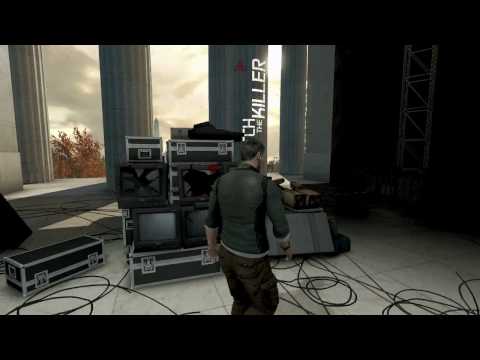
The pièce de résistance, however, is the aforementioned virtual camera, wobbling and shaking in response to terrible acts of violence, nowhere more so than during the handful of morally dubious "interrogation" sequences. These pop up maybe half a dozen times throughout the campaign. In essence, these are sequences where one guides Fisher though a series of scripted beatings(ones Jack Baur would find excessive) to extract perfectly accurate intel from people as varied as scumbag dope dealers to powerful African American politician arms dealers. Incidentally, Fisher beats this latter man up in the Lincoln Memorial. Right there, at the feet of the Great Emancipator himself. I found myself wondering if the developers thought they had delivered any of the dramatic irony during this tasteless and insensitive set-piece or if they just thought the Mall was a great place to smash a guy's head though a wall of televisions at.

This once had an African American bad guy's head inside it.


Still, when that gentleman's head gets smashed into a wall of televisions as the camera circles and vibrates like something out of Children of Men, it looks amazingly painful and very cool. Sam Fisher may not have all the information on how appallingly unreliable information gathered through torture is, but I don't believe Fisher was ever steered wrong by his detainees over the satisfying, if brief, single player campaign.

However, one gimmick felt very pedestrian and flat to me. It was the most highly touted "feature" in all the pre-release coverage of this game, this "Mark & Execute" gimmick. Melee dispatch a dude with the B button, and you're on your way to Mark & Execute somewhere between 2 and 5 other dudes. Press the right bumper when said dudes are in your line of sight to capital M "Mark" them, then slam that X button down with AUTHORITY to capital E "Execute" those suckers.

I may have just played the game wrong, but I only did this between 3 and 6 times during the entire course of the game (if we exclude those moments where the act is mandatory to continue). If one truly embraces this system, it might help them get out of some of the hairy moments the late game can throw Sam's way -- but I found it more trouble than it was worth. I just aimed for a dude's head when no one else was looking.


I'm woefully under-qualified to review a Splinter Cell game in context. I've never played one before this installment. I make no claims for my gaming prowess. I have little of it. I've been stuck at 75% in the XBLA game Limbo for nearly half a year now, and I've played it just about every week since I bought it. I've done everything save watch a Youtube clip explicitly telling me how to solve it.

Still, I'm recommending this game. It's 20 bucks on Games on Demand. I spent about that much on a belt today.

I've enjoyed the belt much less so far.


12.01.2012

Tips for the NBA2k13 demo available now on PS3 or XBOX live: sefolosha sefolosha sefolosha

*Note: these tips may or may not improve your NBA 2K13 demo skills. 

*Note: These may or may not be "tips" so much as "suggestions to amuse yourself while playing NBA 2K13's five minute demo."

Here's my list:

 Tip #1: don't slam on all the face buttons while waiting for your demo to load. NBA2K13's demo will hard lock your system if you hammer random buttons. If you've grown accustomed to hammering random face buttons, vainly attempting to bypass NBA legalese or middle ware logos, quell your impatience. 

Tip #2: press 'start' to enter the pause menu. Find the option "choose sides." Press A after it is highlighted, then press left twice on your left thumb stick to select the Oklahoma City Thunder.

Tip #3: Unpause the game. You will now be in control of overpaid center Kendrick Perkins just as the first jump ball of the demo leaves the referee's hands. Tap up on the right stick at some point; it matters little, because Chris Bosh is going to get that initial tip 70% of the time. 

Tip #4: Press the "A" button to cycle through the starting lineup of the OKC Thunder. If Miami has the first possession of the game, avoid direct control of Theo Sefolosha or Kevin Durant, because Wade or James is going to get by you and make you feel silly. In fact, don't bother trying to play "real" defense. Just try to jump into as many passing lanes as you can. 

Tip #5: After LeBron James or Dwayne Wade score, inbound the ball to Russell Westbrook. Direct him to walk across mid court and begin moving towards the near (left) sideline just outside the three point arch. Slam down the sprint button (RT) and head towards the paint for an uncontested layup.

Tip #6: When on defense, try to play as Serge Ibaka at all times. Take an unorthodox approach: freelance at all times. Ibaka has no designated assignment and no designated position in a five minute demo. Attempt to draw as many charges as possible (to draw a charge, press the B button). It won't usually work. Have Ibaka full court press, by himself, every possession. Try to get as many fouls as possible against the elite competition. 

Tip #7: Kendrick Perkins and Theo Sefolosha are not allowed to score, even after an offensive rebound. Have either of them kick it to Durant or Westbrook - one of them is almost always beyond the three point line - and the numbers favor one of your stars swishing that three vs. letting those two chuckle heads attempt any low post put backs. If Kendrick Perkins scores, restart the demo. If Theo Sefolosha scores, he is the only player allowed to shoot for the rest of the demo. 

Tip #8: If you feel as though either Russell Westbrook or Kevin Durant has missed a shot they'd make in real life, reenter that pause menu, switch over to the Heat, and force Shane Battier to take a mid court three pointer. It is likely to miss, and OKC is likely to get the rebound.

Tip #9: At some point, Russell Westbrook's going to have between 12 and 18 points, and the entire Heat defense will collapse on him. Start driving into the paint and passing to out to whomever is standing on the right wing. If it is Kevin Durant, take the corner three. If it's Kendrick Perkins or, God Forbid, Theo Sefolosha, continue passing around the horn until Durant has the opportunity to take a three. 

Tip #9a: Every now and then, let Durant try to muscle his way to the basket. Unlike Westbrook, there's no guarantee that Durant will get past LeBron James, but the disruptive move will free up even more Westbrook scoring opportunities.  

Tip #10: This game is only five minutes long, so it doesn't matter how much your opponent scores so long as you remain at least tied at the conclusion of those five minutes. Don't bother trying to adjust any shots or switch off on pick and rolls. The sooner the Heat score, the sooner Westbrook's getting another and 1.

WHAT YOUR FINAL BOX SCORE SHOULD LOOK LIKE: 

Russell Westbrook: 14-22 points
Kevin Durant: 4-9 points
Ibaka: 2-4 points
Kendrick Perkins: 0 points
Serge Ibaka: 0-12 points (depending at what time he scored his first basket) 

I have found this to be a most entertaining way to play the five minute demo for NBA 2K13 produced by Jay-Z, and I've put over four hours into it.

10.13.2012

What We Write About When We Write About Our Failures

There has been so much wasted time trying to perfect the newest Shop Keeper's Unit for this intellectual property of mine. Usually, I'll spend something like 2 hours wrangling a bunch of jottings written down as I played a video game. I'll write things down on whatever is handy, be on paper, be on textedit, sometimes in the notes section of my phone. I'll get tired of that around 3 or 4 in the morning and just publish whatever I got. So what I hoped would be a think piece about the evolving nature of virtual cameras and the redefinition of cinematography through third-person shooters becomes a bad review with lots of stupid jokes in it. For a couple of weeks I remember "oh yeah I'm not the dumbest or worst writer in the world." Those feelings crater after I re-read my output. Then I panic, because something published under my own Christian name is out there for the world to see, without any copy editing. So down that thing goes, because maybe I would like to get back into a more professional capacity vis a vis this whole writing thing.

So instead of giving up, I'm going to try to show more of my work. I bet I will not succeed. Any blog-post missive that signals a new commitment to the format or a promise to redouble the output on the aforementioned blog is ultimately the sign of a dead blog. 

But oh well. Plus, I barely have I life so I've played quite a few games!

For instance, in the last twelve I have played to completion: Splinter Cell: Conviction; Mass Effect 1 and 2; Dust: An Elysian Tale; Kane and Lynch 2: Dog Days; Fable II; Bayonetta; and Assassian's Creed II. I guess you can't really beat Trails Evolution, but I've certainly logged multiple hundreds of hours playing it. 

I have thoughts on these games! They aren't all timely, or coherent, but they're mine, and I think people should be free to explore my thoughts if they so chose! 

 So maybe I'll try throwing some of this stuff up more frequently, no matter how much it reads like a freshman's English free-writing exercise. 

So here's a little taste of my thoughts on Mass Effect 1 - including my thoughts re: my talent at expressing the aforementioned - which is a game that is nearly 5 years old when I type this:

There's going to be a lot of unorganized thoughts and insufficiently proofread paragraphs. There will be sections where I missed a crucial punctuation mark or even entire half sentences in my zeal to move certain paragraphs into more fitting contexts. There's going to be jokes that go nowhere. There's going to be outright falsehoods. To wit: at one point, I promised not to spend much time detailing the mechanics of the gameplay, because you could read all about that stuff in an IGN review or whatever. Then I spent something like 800 words detailing a gaggle of mechanical details. You will read jokes that go awesome places, because I'm not bereft of any talent.

I want to write about these games because I liked them. Not as much as QWOP, of course, but I did like them.

I want to write about these games because In the AAA space, the first two Mass Effects qualify as brave. Choices have consequences; those consequences can be profound and disquieting. Mass Effect do not let you critical path your way to a flawless ending. People will die, on orders given by your Shepherd, in this virtual world. Some of them will be members of Shepherd's crew, people who have volunteered to serve under your command and confided their shames and triumphs with Shepherd. Some will die at Shepherd's own hand, pleading for undeserved mercy.

I want to express my profound appreciation for Jennifer Hale's excellent performance as "FemShep," and I want to continue some of the dialogues my roommate and I have been having about this game since I picked it up on the relative merits of "BroShep." 


9.12.2011

Persona 4: Not Much To Say, It Turns Out

Well, that last thing didn't turn out so great. Let's hope for something a little less... grotesquely malformed this time around. Persona 4 is what prompted me to return to very bad games writing, after all, yet here I see nothing about Persona 4 yet posted on the blog. Don't think it has been a lack of trying on my part -- well, it has largely been due to a lack of trying, but half a dozen attempts have been made to untangle this particularly unwieldy ball of twine. Sadly, the inexorable passage of time has somewhat dulled and fuzzed  any perceptive insights I might've once had on the product, and there is little chance I can contrast those illusive insights into something that is not a fever dream.

So this is what I have to say about Persona 4:

Persona 4 is a lot of things, but before anything else, it is a staggeringly competent product. In a world run by a kind and just God, this wouldn't be such a big deal. However, considering the state of the Japanese RPG in the world of 2011, seeing a JRPG that:

  1. Has a sure sense of itself, of what it is attempting to do, of pace and plotting, of basic gameplay mechanics - in short, a raison d'etre 
  2. Was released on time and on budget
  3. Is mostly (...mostly) lacking in the kind of abhorrent moe fan service plaguing the Japanese development scene 

...well, that's just short of a miracle.  

One day, I'll get back to it. (No I won't).

7.19.2011

"Bully!" - Theodore Roosevelt

- THIS ARTICLE HAS BEEN EDITED SLIGHTLY SINCE ITS INAUGURAL POSTING.

Bully, the 2006 Rockstar Vancouver PS2 game, is so very close to an unqualified success. At the time of its release, no Rockstar product was even close to Bully in those nebulous and subjective categories at the bottom of, like, an IGN review. It looked better, sounded better, played better, felt more cohesive. It was less self-congratulatory. Yet the experience of playing the thing can be - nay, must be - extraordinarily infuriating, because an open-world game, by definition, is one wherein the game's narrative and the player narrative's can diverge grotesquely, with no consequences. The ludo-narrative dissonance has only grown more pronounced in the aftermath of Grand Theft Auto III, and this, I cannot cotton to.


Bully is set in this idyllic little resort town, one built over the dilapidated remnants of some bustling 19th Century factory town or iron works. The school itself is both highly exclusive academy that caters to the inbred sons and daughters of business tycoons and Senators and reform school for 50's greasers unstuck in time.

Searching for consistency at Bullworth Academy is a lot like looking for a bus stop in a city where you aren't sure if there's a bus line.

So this is kind of where everything begins to crumble. Like, Groton does not share a campus with some Hardass Military Reform School. For every articulate line of dialogue or genuinely moving storytelling beat, there are five incest jokes that are not funny, not original, and not well delivered. For all the refined and clever twists on familiar open world bullshit story mission tropes, there's still all those mandatory races these damn games cram awkwardly between more interesting moments. Each gem of an idea is isolated in a barren, somewhat disjointed simulacrum of adolescence. There is no firmament to bind this place together, to bind all the disparate gamey bits, all the cut scenes, all the absolutely immaculate Danny Elfman-esque soundtrack cues, all the interminable bike races, all the dodgeball games, all that is interesting about it together. Instead, there's a Qix minigame one must master to improve their ability to woo young women. Or there's the sub-Contender (Contender being a little remembered and very awful PS1 boxing game released in 1999) boxing minigame one must master to progress beyond the first quarter of the game's narrative.

While no one has any genuine use for A Separate Peace made manifest in a world of video games, I would have liked to see it woven throughout Bully. If Bully had been A Separate Peace without all that gay subtext and crew team stuff I feel confident I would hate the game much more. Let's face it. That's a horrible idea. Even so, at least A Separate Peace would have generated an active, interested kind of hate. Instead, it's all so "meh"  Bully has a lot of genuine things to say about adolescence, about what is just in an environment that respects violence above all, and there's a genuinely unexpected and resonant twist near the end of the story.

The road traveled to that conclusion, all thirty-five hours of it, is largely filled with bike riding and savage beatings -- beatings Jimmy is only tangentially involved in starting, but once shit gets real, there's a lot of knees to the balls and cricket-bat whackings. Jimmy is presented as a bit of a simpleton, willing to go along with almost any preposterous scheme if it involves vandalism or protecting his staggeringly incompetent, drunken English Teacher from a deserved firing. All high school problems can be solved with violence. Girl problems are a little different, and even easier to solve. Flatter, give flowers, and prepare for make-out central. If a girl you've made out with sees you making out with another girl, they'll fight, but they'll forget all about it the next time the roses get broken out.

There's no memory here. Everything is ephemeral, and pointless. Unlike the other high school game I'm going to contrast this with one of these days, swear to God, Persona 4, each day's event's are isolated little vignettes that build a larger narrative like a late period Godard film, or if everyone in Groundhog Day retained some kind of Jungian collective unconscious.

You know what? Go read Tom Bissel's piece on LA Noire at Grantland.com. That's my problem with barely keeping a blog about videogames, a topic I'm not sure I much enjoy right now anyway. Tom Bissel and Chris Dahen and Michael Abbot are just super good at it, and they don't need to make lame jokes like I do.
and for no reason, here's a picture of God Hand.


You know what? Just go play God Hand. That needs to be placed into the western canon, alongside Paradise Lost and Joyce's Ulysses.

Fuck, that didn't turn out at all how I hoped it would. Tough cookies, all 12 of you who read this.   

5.26.2011

Bully, Persona 4, High School, & The Perils of the Open World: Introduction

Consider the high school. While the advent of the institution as we think of it today is less than a century old, its tendrils have burrowed so completely into our consciousness it seems to have existed forever, outside of time. It is something mandatory, something we view with a mixture of contempt, romance, and bewilderment in our adulthoods. Everything was the most important thing to ever have happened for about 20 minutes, replaced by the next greatest event. After Jimmy Stewart and Robert Michum died, every movie was either set in a high school or calibrated to appear as though everyone in it was in the arrested emotional state of a 10th grader.
High school was a thing that did not exist for most of the medium's history. River City had one, of course. It even organized sporting events. The Garden in Final Fantasy VIII was kind of like high school, for orphaned killing machines. Otherwise, nothing. 
Nothing, save Atlus's Persona series. An offshoot of the Shin Megami Tensi franchise, Persona has overtaken its parent and straddles the Japanese RPG world like a colossus. 

I started playing Persona 4 shortly after it came out Winter ‘08, smugly assuming I would discover all of its mysteries and defeat the major antagonists well before April 11th, 2011. That was some crazy future-day. A special one, to be sure, the day this sickly, bespectacled teenager (I named him Chris, because that is my name) from the big city was to arrive in a quaint little resort town for the school year, knowing not what terror lay ahead for he to thwart.


Well, I beat Persona 4 a handful of days ago - I do wish I'd have done it on April 10th 2011, because of my largely fictional OCD. The game clock reads 103 hours. That’s, let’s see, about 9 minutes a day of linking my socials and fusing my Jack Frosts with other Jack Frosts. It wasn’t a perfect game - Pac Man Championship Edition CX is the only perfect game - but it brought  all the things I adore in the frequently maligned Japanese Role-Playing Game genre into a high school setting.

Persona 4 is not the only game set in a high school that I've randomly played recently. There is also Rockstar Vancouver’s Bully. Released in 2006 for the PS2, this game must have sold well, because I don’t think any secondary marketplace - your Gamestops, your pawn shops - has fewer than 90 copies of it lying around. Like, there’s more copies of Bully than all the Madden games put together.


Let me be upfront: I have huge, irrational problems with Rockstar and their games. I’ve hated their sophomoric jokey tone and their functionally broken camera and aiming mechanics. I've hated the dissonance between the open world, let’s fuck around sandbox aspects and the mainline story missions. I’ve hated the number of those story missions that are simply janky races on ill-defined courses. I’ve hated the half dozen or so impossible roadblock objectives where you have to pilot a goddamn remote control helicopter or whatever that no reasonable person can be expected to satisfactorily complete, but which must be finished to unlock more of the entertaining sandbox stuff, and I’ve hated how smug their entire enterprise reads to a guy who mostly just wants to see dudes with anime haircuts hit each other with swords, be it an RPG, a fighting game, or that dubious moniker “character action”: the Devil May Crys, the Bayonettas, and the like.

Rockstar has started to win me over - Red Dead Redemption told a story worth telling, although in typical Rockstar fashion, our protagonist was required to sometimes act heinously on the behalf of some vile yokel in direct violation of his redeemed character. The wild west setting kept that ludo-narrative dissonance from bothering me as much as it does in Grand Theft Auto. LA Noire sounds pretty neat, and Ken Cosgrove and Peter Bishop are in it.


These Rockstar games are all open world games, promising you the freedom to do all sorts of fun things. Because games should be fun. Fun fun fun free fun. Persona 4 comes from different stock - the dreaded “linear” “Japanese” school of game design. In this case, “freedom” is the hobgoblin of small minds. Outside of Nethack, the games designed by Yasumi Matsuno, Clint Hocking, and that fellow what made Minecraft, Persona 4 gave the illusion that there were more opportunities to push the limits of a game’s systems and mechanics than the stereotypical JRPG, and invested me in its world more successfully than I can readily recall. Bully... well...
NEXT: A LOOK AT BULLY


5.23.2011

Holding Pattern


We are coming up on a year since words have appeared here at A New Sku, an ostensible resource for C.P. Ervin themed commentary on games and their intersection with video, design, and alarmingly ill-conceived meta humor.

Is this most marginal of blogs offline forever? Not at all. In fact, I hope to have a few pretty neat things posting here in the next three months, assuming I can wrangle my mess of notes, asides, jokes and silly ideas into a coherent argument. It can be rough to extract cogent thought from a 15,000 word Google Doc about high schools in videogames, I've learned.

Now the promise is out there. I can't welsh on the 2 of you who still have this in your RSS readers.

7.20.2010

Goodnight, Sweet Prince: Cavia's 10 Year Run


I somehow missed a sad bit of news last week: cavia [sic] ceased to be a going concern. Happily, most of the developers are still employed, as it sounds like the majority of the studio's employees were absorbed into parent company AQ Interactive. While this isn't the most shocking studio closure in history, considering cavia's uneven (to put it kindly) track record and general profitability, this is one that hits close to home.

Cavia took a lot of contract work, pumping out Playstation 2 games with suspect anime licenses. This kept the lights on and the capital flowing into their original intellectual properties - not entirely unlike WayForward, a studio whose profile rose significantly after Scribblenauts' surprising sales. Cavia, alas, had no surprising successes, critically or commercially. I guess Neir seems to have attracted a cult following - deservedly so, considering how wildly ambitious and varied it is - but no developer can survive on cult hits when the HD console space's cost of entry is stratospheric.

So why mourn the passing of this studio? Why should those responsible for Bullet Witch and Beat Down: Fists of Vengeance get any postmortem respect?

A lot of my feelings are divorced from reason, I'll admit. They stem from a simpler time in my life, when all a game needed to impress me was a sweet dragon. As a child, I just loved dragons. I no longer carry such passion in my everyday life for the mythical creatures, but if I see a $4 copy of some game I'd never heard of that obviously is about dragons, I'm buying it. Cavia developed exactly that kind of stupid impulse purchase dragon game, and it was called Drakengard here in America. Maybe I got it in 2005? In any event, to me this PS2 game was an unknown, mysterious thing, dangerous and enchanting. I had no idea what kind of game I was to be playing before I slammed it into my system, and I still don't know what I had gotten myself into.

Seeing the SquareEnix logo cheered me immediately - there's a company that releases high quality games, usually. Formulaic, yes, but quality. And then the cavia logo found its' way onto my television. I liked the name of the studio - even a usually infuriating affect of a company not capitalizing their title, flying in the face of how I expect proper nouns to be presented to me - and I liked the logo: clean, with a stark black/white/red color scheme.   

"This augers well!" I thought.

The game is a Dynasty Warriors knock-off. I say this with no enmity - Dynasty Warriors is hugely popular in Japan, and any sane company would try as hard as it could to exploit the market. No matter how much we clamor for innovation, a well made knock-off is what we will spend our money on. This Dynasty Warriors knock-off takes place in some fantastical world with dragons and civil wars and faeries and boulders and lute playing ninnies. There's a princess, who might be a god, or something, and you control her brother (I think he's her brother, but they also imply something incestuous between them, or maybe they're related by marriage... it was all very confusing). About ten minutes into the game, Caim (our protagonist and playable character) merges his soul with that of a dragon. This costs him the use of his voice, further complicating matters of exposition and plot development. The dragon talks to Caim using some kind of telepathy, but everyone hanging around the dude can also hear what the dragon's saying, so maybe sounds are being produced though the magical markings on Caim's tongue, maybe? Oh, and once the dragon starts talking, it sure doesn't shut up. Much of the conversation is philosophical in nature: the dragon asks Caim 900 times why he is such a murderous bastard. Because Caim cannot answer, the discussion grows tiresome. Very, very tiresome.


Drakengard tries to spice up the hack-and-slash-and-hack-some-more repetition common in all Dynasty Warriors clones by inserting a motherfucking dragon into the fray. At nearly any moment, hitting select will summon your flying friend. Caim can mount the dragon (heh) and fly across these preposterously large maps to another area lousy with evil, just incinerating legions of enemies ill-equipped to handle a goddamn dragon. Later in the game, magicians and trebuchets will provide overpowered countermeasures to this death from above, ruining a lot of the braindead fun.

Breaking up these large scale battles, some flying sequences happen. These are reminiscent of those open boss battle levels in Star Fox 64, filtered though Panzer Dragoon's lock-on mechanic and general love of dragon riding. The game, surreal enough as it was, achieves a sort of transcendent nonsensical atmosphere here. My personal favorite moment: when the dragon is attacked by what appear to be flying dressers or silverware cabinets.

I would have loved Drakengard had it not been for one absolutely crippling flaw: the game is sloooooooooow. This fantasy universe must have tremendously heavy air molecules. Caim, a fit young warrior by any standard, is not much of a runner. The glacial pace of this game, a game that absolutely requires some serious manic energy to work, slaughters much of the potential fun.

Which is a shame, because -- dragons! And magic! And a story so confusing it entertains on a basic, campy level! Also: it was clear an insane amount of work went into constructing this bleak, nihilistic fantasy world.

There's something like 80 weapons Caim can acquire, each with a lengthy backstory you can read in between missions. If there's a thing you can do in the game, chances are experience can be earned by doing it. The RPG elements are laid on inelegantly, but with such enthusiasm it doesn't matter. Caim levels up. The dragon levels up. Each individual weapon levels up. The spells associated with each weapon level up. It's impossible to keep track of all this, and ultimately futile - the default sword is about the only thing to use, because by the time the rad lances and maces are acquired, these new, sexier weapons are too underpowered to be of much use. Momentum is the utmost concern during the Dynasty Warriors bits - chaining a few hits together will grant Caim the ability to unleash a powerful thrust capable of knocking to the ground foes nearby. The default sword, having been in use for more of the game than any other weapon, will inevitably be the most momentous weapon available.

Drakengard 2 significantly sped things up - yay! - whilst gutting much of the intriguing story elements - boo! Crucially, the game engine and graphics were not updated or improved up one iota in the intervening 3 years between the games. While the budget for the first game must have been at least moderately large (there's quite a few impressive CG cut scenes), it's pretty clear almost no money was spent making the sequel.

So Drakengard (called Drag-on Dragoon in Japan, which is a much more amusing name if nothing else) holds a weird place in my heart. So does Ghost in the Shell: Stand Alone Complex, a fully functional PS2 third person shooter from Japan that most definitively does not hold up today, but had wonderful pacing and some neat mechanics for the time.

The greatest product cavia produced, however, wasn't exactly a game - it was a tool, a fairly powerful and affordable tool, for the Nintendo DS.

The KORG DS-10 is a fully functional synthesizer modeled after the MS-10, complete with four different emulated drum machines and the ability to use the touch screen to simulate the KAOSS Pad, all for $30 bucks. There's some serious limitations to the software: the step sequencer is basically Fruity Loops, only not as good; while the program emulates two synthesizers, each one is monophonic, so chords are out of the question; because the DS is not a multi-touch screen, the KAOSS Pad is not fully functional; the interface, while classy and modeled after the MS-10, can prove slightly more cumbersome than one may desire; you can't change sequences while they're playing, which is a huge bummer... it's still just $30, one tenth of the price of an entry-level KAOSS Pad. And the emulation of the MS-10 is unreal, coming from a DS cart. While I haven't personally found much use for it in my own musical compositions, mostly because I don't know how to properly deploy flanger effects on the busted ass drum programs I hesitate to say I "compose," it's still a lot of fun to play around with.  

So yeah, cavia. I have more things to say about both Bullet Witch and Neir, but those need their own posts, written at a time when I'm less tired.

4.11.2010

The Worst Piece of "Jetpack Goonies II" Fiction You'll Ever Read.

This is quite possibly the stupidest thing I've ever written. Wait, it's worse than that. This is empirically the stupidest, most ill-conceived thing written in the history of man. I can take a kind of pride in creating such a foul block of verbiage, actually.

How do I even set this up? Well, I'd been reading Don DeLillo's gargantuan novel Underworld. It's a solid entry in the "Great American Novel" style: overambitious, unwieldy, oppressive, stunning and wonderfully obtuse. Anyway, DeLillo is famous for his weird, hyper stylized writing style, one of the most immediately identifiable traits in the whole of creation. Maybe I could more readily identify a passage from David Mamet or Henry James - but that'd be about it. It is also a blast to mimic his terse, elliptical writings.

So, while in a state of extreme boredom, I tried to fashion the story of one man's dream to make The Goonies II NES game better with jetpacks in the style of the preeminent wordsmith of the Cold War era.

This was the hideous result.

A kid skips his computer science class. Goes and plays Goonies in the Aladdin's Castle. Says to himself this is the life for me. To entertain, though the medium of computer science.

To make for others what has been made for him, to kill the inchoate nature of being alive and being a teenager.

Goonies ain't perfect, fuck no. Lacking in verisimilitude. Worse. Lacking jetpacks.

His parents laugh in unison, laugh so hard they start coughing on their menthol cigarettes. But they humor him, lend him enough to start something small. Never expect to see that money again.

What doe he do?

This guy, maybe he's a popular fellow, maybe he's not. He's not known, but he strikes something in others. He meets them attending conventions, conferences, tells them what he's got on his mind without overplaying his hand. Mostly, he meets them without seeing them. They are names on the screen. Maybe they're popular men like himself. He's not done so but he would add "or insane." Helps if they're driven. Always men.

Always men at first, but later women. Who share something of his vision. Or lack vision but do not lack perseverance.

Astoria.

This guy has his men. Some women, now. But needs are greater now. He needs to take care of this, his friends and backers and workers. He'll run their lodes best he can, but he's not a businessman. Not now.

Shit. Business.

Business is something else. The money and the greed to generate more money. He and his men have the idea, but the idea is not a Business, man. The idea is the world.

There are layers, here. This guy, he's a popular fellow. That's what everyone says, now, although not him, not aloud. What he is - he's known without being famous, you see, and the clout that comes with that? Nothing like it. He's not compromised. How can you work when you're famous?

How could you live totally unknown?

Working working, always working. Always with his friends, backers, some are calling themselves workers now, just like him - what they've joined to do is make the world.

But they are miles under it now. No matter. The world is there.

He's max on his Visa, his AmEx. Takes mortgages after mortgages on the dead parent's home. Thank God he inherited only this from the dearly departed - not the bad habits. Could have been much worse. Thank God.

Remolded the downstairs and garage and now it looks just like any other office. Computers. Render farms. Prototype is not done but it's proof of concept, and no one has ever seen a better proof. You can work it the other way but nobody does. The video shows you what you need to see.

The coffeepot's always empty and no one ever cleans and brews the next batch when they're done.

How can you readjust Jetpack Goonies before seeing your vision manifested? And now? We can see the basics. The underworld stabilizing what's above. Mechanics are still theory, but sound theory. We've checked them. Against themselves and against the projections. The philosophy behind it is solid. Theoretical still, but look at what we've got. We can see it. There's proof here, now.

1.10.2010

Meanwhile, in the foulest depths of the Internet...

I wrote a decade wrap-up over on my tumblr. I want to make it as difficult as possible for people to find my writing, in any case.

3.22.2009

"I Hope That's Not Chris's Blood"

Here's some thoughts on Resident Evil 4. They're pretty much identical to my feelings re: Resident Evil 5, actually. Why is this series so frustrating to me, and yet still so endearing? One of life's mysteries, I guess. Also, this essay is a goddamn mess. I don't know why I'm posting it.

Resident Evil 4 is winning the lottery a few hours before getting diagnosed with terminal cancer. Resident Evil 4 is a reunion with your childhood sweetheart, now mired in drug addiction and madness. Resident Evil 4 is the affordable, rustic old house with a shockingly low rent and 
a wonderful view of the city; Resident Evil 4 is also the roommate who never does the fucking dishes. Resident Evil 4 is large; it contains multitudes.

Resident Evil 4 calls itself a "survival horror" game. You may not understand what a "survival horror" game is; that's okay. Capcom has no idea what the "survival horror genre" is, either (so is it horror to survive?). As the abecedarians [it seems like the most accurate word to use, douche-y as it makes me feel] behind this weirdly compelling marketing-speak nonsense branding, Capcom was the moral compass to all the other developers of "survival horror"-esque games. No, they were more than a compass, they were a role model, like Sandy Kofaux. Just as Kofaux's famous decision to sit out the first game of the 1965 World Series because it coincited with Yom Kippur inspired countless Jewish sportswriters to write identical columns about how brave and inspirational Kofaux was every Yom Kippur, so does Capcom's brave embrace of anachronisms inspire others to embrace anachronism. When one sets out to make gobs of money with a spooky videogame, one must examine the Resident Evil franchise intently. How stingy should one be with ammuntition in the game if one expects a player to survive the horror? How many rubies must one pry from the eye sockets of marble statues? And should there be marble things other than statues, with emeralds instead of rubies crammed into various places? What is the optimal ratio of marble statues to other gem-hiding objects ? How often should these rubies and emeralds be inserted into hidden mantelpieces behind trick bookshelves before a horror can truly be survived?

Nevermind how much the Resident Evil series borrowed from Alone in the Dark. Alone in the Dark never owned these conventions as Resident Evil owns them. Alone in the Dark was so awkward to control, and so ugly, I could never get past the first 20 minutes or thereabouts. If I wanted to survive horror whilst playing Alone in the Dark - hell, if I wanted to tell my friends what happens after advancing past the first couple of spectral encounters - I would have needed serious commitment. I imagine "solving" Alone in the Dark was similar to entering an empyrean realm of joy and enlightenment. I'll never know. I'd get bored watching someone else play Alone in the Dark. I'd rather go off to buy a cheeseburger and some Magic: The Gathering cards or whatever. No, without Capcom's help, the "survival horror" tropes might simply have disappeared, and we'd live in a world where Konami might have implemented something like, oh, let's say functional controls to Silent Hill 2, the undisputed masterpiece of this whole silly genre, and what a tragedy that would have been! Defenders of the tank controls tell us a 'widely believed fact' that busting a player's ability to interact simply with his game "increases the tension and makes the game scary." These mouthbreathers also find the incredibly limited resources scattered obliquely thoughout the game something of a turn-on; the very idea that you cannot save your game without ink ribbons is enough to excite them.

No more! With a simple shift of the camera and a creepy guy willing to sell you massive amounts of weaponry, Resident Evil 4 not "survival horror." It is something else entirely.

It's fair, for one thing.

Every failure to survive the horror is instructive -- and, due to some smart planning on the part of the developers, most scenarios allow for quite a bit of freedom, depending on how adept you are at improvisation and the availability of ammunition, This breadth of options is the best thing about Resident Evil 4, and it's a wonderful consequence of the obstinate, fixed camera's demise.

The change from the pre-rendered backgrounds and frustrating camerawork of RE's past to the more traditional third-person camera found in this game once prompted some internet commentators to declare this a complete break from the bad old Resident Evil ways. Their enthusiam is only partially warranted. Due to the extreme emphasis on shooting gooey things in this iteration of the franchise, that old, German Expressionist-influenced series of pre-rendered rooms would have crippled the game. Seriously, though, this is kind of a clunky and unintuitive half-solution to the problem, not a revelatory departure from the old style.

The function of the Resident Evil camera is to generate a mood -- claustrophobia, creeping dread. Fear, in short. I'd hate to see Shinji Mikami's (now Jun Takoishi's) team of developers allow anyone to program some full, freely adjustable camera, because the shlock horror style shocks of the series depend greatly on shlock horror tactics borrowed from films as old as "The Cabinet of Dr. Calgari," or Bela Lugosi's "Dracula," and as new as, um, "Resident Evil: Apocalypse."

The still-clunky controls also fit the game better than they probably should, because it's clear a lot of thought went into pacing and designing your typical LAS PLAGAS encounters so the specific limitations of the control scheme are moot. This elicits a confabulation of excitement, tension, dread, exhilaration, and an increased sensation of personal self-worth when playing.

It's clear just as much thought went into the first third of the game as did the control scheme. While the game is rigidly linear, each major location where killing's gonna be going down is filled with dozens of options as to how said killing will actually go down. Never are you stuck in a linear corridor with tenticle-headed monsters blocking your forward momentum -- at least, not during those crucial first hours.

Resident Evil games have always cultivated a sense of desperation, but prior to RE4, the balance between the "I don't have enough ammo or herbs and I've got to run though this hallway and GOD I hope I have an ink cartridge so I can save my game," moments, and the "I just got me a big, new gun, and I got plenty of ammo, time for vengeance!" moments was never quite right. Here, again, things are different.

RE4 - which is much, MUCH more action packed than previous games in the series - gives us opportunities to experience genuine power uncommon in this made up genre. Fairly early on, we're treated to a set piece that illustrates what amounts to a philosophical change in "survival horror" perfectly. While riding down a ski lift, or industrial crate transport, or something, I had trouble arriving at my destination until I equipped a bolt-action sniper rifle -- a weapon I had used not once the first 4 or so hours of the game, because, hey, I like to look my kills in the eye as they die. Imagine my delight when a handful of well-aimed shots -- three dead zombies per round, when they were queued single-file --ended the ambush on the little train-car-thing before it started. Not a single injury to myself or my traveling companion during the entire gondola trip -- and around 14 corpses re-corpse'd to my credit. Never were there killing sprees like this in Resident Evils past.

Also, goddamn. This game looks great, and it isn't just flash for the sake of flash; the technical proficiency is married with a perspicacity to the overall atmosphere. Nothing is done just becuase some whiz at tech whipped up a rockin' new shader. It's not showy or gaudy in the way something like Devil May Cry is. It's atmospheric.

Sadly, as I write this review, I admit waning interest in the game. Moving out of the village and into a more traditional RE setting -- a musty castle -- gives me the feeling that, before the adventure is over, I'm bound to see some abandoned laboratories where mad scientists devise unspeakable chemicals. The plot is going to continue along it's convoluted, half-retarded path, and it is likely that I will murder, if that is the word, hundreds more of these quasi-zombies.

So. If a AAA Capcom production of one of their flagship franchises, intelligently updated to both revive a staid product without fundamentally changing it's cadence can lose my interest with an almost admirable, if shocking, legerity -- well, there is a fundamental problem at the core. I think that problem might just be me and my interests. It also might be a problem with the game being too padded with nonsense to extend that length.

But -- there must be a middle path between the mental anguish and pain the Silent Hill protagonists face and the cheesy scenarios our friends from Resident Evil endure. A videogame that manages to be both thrillingly creepy and populist without suffering from Stupid Plot Syndrome is going to be huge. Fatal Frame? Siren? Maybes. I'm pinning my hopes on Heavy Rain, which is unlikely to be a survival horror game per se but will at least have serial killers and stuff in it.

Well. Maybe it's not that. It's just - the Resident Evil formula doesn't feel like homage any longer. It feels like self-plagurization. I've read elsewhere that this is a 20+ hour video game. I'm already starting to sense that the game doesn't have many more tricks up it's sleeves, after that phenomenal first 3 or 4 hours. I'll finish the game if I can find time, because I have faith that there will be a few more bright spots along the way. That I feel obligated to complete it rather than compelled to see the conclusion saddens me.

2.02.2009

From the Ledger of the Apothecary

March 18th in the year 18 of our Lord the Goddess - Our town remains under siege. The fowl archmage Domminous sent his minions to raze our crops a fortnight ago, and despite the best efforts of our stoutest warriors, vile creatures decimated our foodstuffs. Needless to say, my shoppe has been ill-trafficked since. Who has the gold for an apothecary's humble curatives and medicines with the price of bread as it is? 

There was but one disturbance at my shoppe today. A spiky haired malcontent, along with a small group of his preposterously dressed friends entered shortly after midday. Having never seen them before, I felt it my duty to investigate, with our town in such distress. They told me tales of their adventures. Upon hearing their unbelievable stories of magic and heroism, I burst into uproarious laughter! These runts told me their aim to defeat Domminous and free the town from his tyranny! It is good to laugh in times as Goddessless as these. 

I sold them 4 curative herbs for my usual rate. 

March 20th in the year 18 of our Lord the Goddess - Oh, Goddess be praised! Our unlikely saviors were the very angst-riddled young men and hot underage women I had dismissed in this ledger not two days ago! Domminous has been riven from the crypts beneath our town, banished across the sea! How I lament my unbelief in these heros! How I lament my crisis of faith in the Goddess! 

I sold them 8 curative herbs at my usual rate. 

April 13th in the year 18 of our Lord the Goddess - It has been difficult, but our little hamlet has nearly rebuilt all the thatch huts damaged in the great siege of Domminus. The crops have been replanted, and my little daughter is not afraid of our pet Dzrogoid any longer. 

Oh, I forget myself! I saw those young malcontents that saved our little village just last lunar month! They told me they were "grinding" nearby. I sussed that this must have been slang for "hunting," as they produced numerous Rungaard hides to sell me. Young people! 

I bought 14 hides at my usual rate, and sold one regeneration potion and 18 curative herbs at my usual rate. 

September 8th in the year 18 of our Lord the Goddess - Although our crops were hastily planted late in the season, they are coming up as thick and hearty as I've seen in all my years. Thank the Goddess! 

Although I am pleased to see our little town as hearty and healthy as it is, I must admit that it is not good for business. Why, my only customers this year have been those heroic adventures that rid our town of pestilence and cast the vile archmage Domminus aside! If only they returned to our quaint little hometown...

I would sell them all sorts of magicks and potions at my usual rate. 

February 17th in the year 19 of our Lord the Goddess - The sky has been blotted black and the island of Islaterra is floating in the sky above our little hamlet. The world is doomed. 

Those adventurers came back today, and I sold them 80 mondo curatives and 4 restoration potions at my usual rate.
 
Not that it matters. The era of Man is ending and the era of Death has begun!
 
February 18th in the year 19 of our Lord the Goddess - My dour disposition has besmirched my ledger yet again! Another miracle at the hands of that spiky haired young lad and his fair lasses! Islaterra is back in the sea, the sun is back in the sky, and (not to be too self-centered) the large purchase of curatives and restoration potions yesterday has filled my coffers! 

Our town threw a large celebration to honor the adventurers, and although we are not as important as cities like Unberpang or Quar the heros deigned to feast with our mayor and participate in a parade. My little one ran next to the enigmatic leader of the group during the festivities and handed him a doll made out of her own hair. 

He handed her two gold slivers - my usual rate. 

10.17.2008

You Best Check Yourself, Fool: Mother 3 Fan Translation Out Today

I think I know what I'll be doing in the foreseeable future.

I am too excited to type coherently right now. Find it here.

10.14.2008

Entertainment Ennui

The annual deluge of holiday releases has begun in earnest this week, and here I am, sitting at my desk, confused and unhappy, struck by waves of exuberance and complete indifference in equal measure.

Left: Hideo Kojima feels the same exuberance and indifference that I do about videogames, only towards alcohol

Few rational creatures follow the enthusiast press as enthusiastically as I do, and if one were to look at my Google Reader or the list of podcasts I subscribe to in iTunes, one might get the impression videogames consume the entirety of my mental faculties. I read gaming related stuff across the entire alphabet, from actionbutton.net to Michael "Zonk" Zenkie. I read the British PC games blog Rock Paper Shotgun; the last PC game I played was probably Irrational's underrated superhero strategy game, Freedom Force -- which is something like six years old (also, Rock Paper Shotgun's British sensibilities are sometimes lost on me, what with their Dues Ex enthusiasm being waaaaaaay out of proportion with what my experience with the game led me to feel). I just read an essay by some Lucasarts employee about the difficulties of choosing middleware solutions best suited for your development philosophy and project goals on GameSetWatch. Weirder still, I enjoyed reading about middleware.

Does this immersion in games journalism correlate to a similar expenditure of energy into the actual playing of videogames? Well, no. Not really. I'm estimating that, since the beginning of July, I have spent my gaming time with the following:

  1. Metal Gear Solid 4 (beat it; still wondering how I'm going to write about it)
  2. Soul Calibur 4 (3 hours against my friend Onuliak; loved it)
  3. Bionic Commando ReArmed (didn't finish the game; wonderful accomplishment, but the level design in Bionic Commando wasn't all that good, really.)
  4. Mega Man 9 (beat it; going to write something about it later)
  5. Vintage arcade gaming at Ground Kontrol (90 drunken minutes; crazy awesome)
  6. Games played at PAX (???)
  7. Final Fantasy IV DS (beat it; it's Final Fantasy IV, and it's pretty swell)
  8. PixelJunk Eden (played it quite a bit; mixed feelings)

Nothing to sneeze at, that -- serious time that could have been spent in more "productive" ways went into gaming -- but not enough time to develop ideas about the experience. When the zeitgeist shifts as constantly as it does in videogame culture, when every AAA game gets dissected incessantly months before hitting retail, disappearing from the conversation a week later, sucked away in the undertow as the next wave of hype crests, when one posts on blog comments sections and on message boards not because one has something exciting to say but because one does not want to feel left out and because it beats grinding a couple levels out in a remake of a Final Fantasy game one has beaten like 5 times... it's hard to keep up. It's frustrating to keep up.

Yet.

Little Big Planet. Mirror's Edge. World of Goo. New, exciting IP. Coming out in multiple SKUs. New ones, at that.


Fallout 3. Yakuza 2. Persona 4. Chrono Trigger DS. Not so new, but very exciting IP. Games bound to take me about a year to finish. Except Chrono Trigger - not a very long game. But I have been playing Chrono Trigger, on and off, since 1998, and having an opportunity to do so on the bus is reason enough to make with the jazz hands.

Fuck it. I only wrote this post to support Blog Action Day (if the script embed worked, there should be a little thing at the bottom of this post. Click on it, would you?). You guys fight poverty. I'm gonna play me some Blazing Lazers.


9.18.2008

MULTIPOINTS

*First, a clarification courtesy of Dark Age Iron Savior, on the SB forums:
is your name actually chris ervin?

also I randomly skimmed your blog and I must unfortunately comment that the main guy behind the awesome Mr. Driller music, Masaru Shiina, apparently never worked on the Katamari games....although he did compose Tales of Legendia, which is kind of weird.
And yes, my name is actually Chris Ervin. I'm too boring to have a neat hacker alias.

*Today the final episode of GFW Radio went online -- with both Jeff Green and Shawn Elliot leaving Ziff-Davis for assistant producer jobs (at the Sims studio and 2k Boston, respectively), there seems little point in keeping a podcast named GFW Radio going, considering only one editor from the defunct magazine from which the podcast was derived , Ryan Scott, is still at ZD. As someone with little money, abundant free time, and a one-time addiction to talk radio, podcasts are perfect for me, and GFW Radio was one of the better videogame-related ones; it's got nothing on the New York Review of Books new podcast, however. Nonetheless, sad to see it go.

*The series of interviews with Japanese gaming personalities 1up.com has been running lately, espically the one with Kenji Eno, have been far more interesting than the typical Japanese devleoper interview, be it a Time Magazine interview with Sawata or a Gamasutra interview with, um, a Square employee or something.

*Hey, I just beat Final Fantasy IV DS while writing this post! Yay!

9.17.2008

The Definitive Word on Braid

I no longer have a 360, so I have yet to experience Jonathan Blow's little puzzle platformer Braid. I've been following Blow's gaseous commentary on the videogame industry as presently constructed fairly closely (he's more than a little full of himself, but he can still make some interesting points) before I knew anything about Braid. While the game has received extensive coverage and sparked many polarizing message board disscussions, I never felt like I really understood what Braid was all about. That is, until I came across Soulja Boy's review:


That's better than anything Hilary Goldstein's ever done at IGN.

In other news, Tatsunoko vs. Capcom coming to the Wii (in Japan, at least). Sweet.

source: wired's game|life blog

9.16.2008

Phantasy Star Online - The #1 Most Acknowledgable Dreamcast Game


Phantasy Star Online could have been the most influential piece of entertainment in console gaming history. Instead, Sonic Team's magnum opus was dead on arrival; Peter Moore announced Sega's decision to become "platform agnostic," on January 31st, 2001 - the day Phantasy Star Online ver. 2 hit retail shelves. It's espically sad when you consider that PSO version 1 was a buggy mess on the scale of Battlecruiser A.D. 3000 -- how many had the oppurtunity to sink 100+ hours into the first really good PSO game?

Sega had the rather unfortunate proclivity to release their best games on hardware that was either dead, or completely untenable to the requirements of the gameplay. See Panzer Dragoon Saga, widely believed to be the best RPG of the 32-bit era. This is nearly impossible to confirm, however, because Sega pressed maybe 10,000 copies of the game. Until I have at least $150 dollars to spend on a 12 year old Saturn game, I can only assume those hyperbolic GameFAQs forumgoers who have devoted so much of their brain to loving PDS they've forgotten the basic tenants of the English language are right.

See also Phantasy Star Online I & II, widely believed to be the best version of Phantasy Star Online, being released for the freaking Gamecube of all things; the initial investment of, oh, $200+ dollars in modems, peripherals, subscription packages, and lord knows what else, to say nothing of the $50 for the game itself, to experience an online game on the least online-friendly gaming system in the history of forever was maybe a bit too much scratch for the average human to spend. Sega, you broke my heart.

This is depressing - let's get back to the Dreamcast game in question.


I believe PSO was the first real time Rougelike (or Diablo clone) on a home console system worth a goddamn[1]. Although I am sickeningly fond of the kind of mindless grindy loot gathering action-rpg, I never got into Diablo. I didn't enjoy spending a lot of time looking at a series of dank, shitty corridors. Also, it turns out, I find the act of hitting a button repeatedly more kinetic
and pleasurable than I find the act of clicking a mouse repeatedly.

I had a predisposition to love PSO, anyway, because the Phantasy Star series is one of my favorites in all of gaming.

I'm still amazed at how well Sonic Team captured the spirit of Tohru Yoshida's designs when transferring them to a 3D environment; despite being a totally different style of game, it is still unmistakably Phantasy Star. The 80's anime look served the game extraordinarily well, both by looking awesome and by connecting the Algol star system's primitive Sega Master System & Genesis appearance to a contemporary system.

PSO lacked only the incredibly sophisticated, ambitious narrative of its' namesake, which is a bit of a shame. Phantasy Star II was a remarkable first attempt at classical tragedy in the videogame medium -- it's still one of the best stories ever told in an RPG -- and to discover the most perfunctory excuses to fetch-quest without any serious overarching storyline in the Phantasy Star universe was disappointing, to say the least. Still, I had a lot of fun in the single player campaign. God knows I spent sophomore year in high school doing little else but play though it, again and again.

Sadly, I didn't play online PSO that often, because online gaming was a seriously janky affair back in 2001, but I have vivid memories of the few time I did get the thing working. Like most slightly monotonous but oddly compelling game genres (the Final Fights and the, erm, Diablolikes of the world), playing cooperatively can exponentially improve the experience. However, the main benefit of co-op gameplay rests largely in the communal environment and in the communication options available to you in said environment. Shit-talking with your friends at the Teenage Mutant Ninja Turtles arcade cabinet inside Chuck-e-Cheeses is an experience one can look back on in their twilight years with nostalgia; playing Final Fight on your SNES (no co-op!) in the garage is just sad, man.

Which makes PSO's masterfully implemented symbol chat system so important, and so great.
Using the tools within the game, you could create your own series of symbols or modify pre-existing ones to articulate your thoughts to other players. The symbol chat is still amazingly versatile; given a little creativity, you can create a symbol to express some freakishly deep (usually disturbing, as was my wont) concepts.

So yeah. PSO was the last Dreamcast game I bought (although by no means the last Dreamcast game I acquired, filthy pirate that I am), and the one I feel most needs acknowledging. I demand you acknowledge it. Now!


[1]
The other Dreamcast classic Diablolike, Record of Loddoss War, came out after the first version of PSO (I think) -- in any case, I played Record of Loddos War long, long after I got into PSO

9.13.2008

Sega is as Sega does

author's note: It isn't done, but I'm putting it up for you, Jackie.
2nd author's note: I screwed up the HTML markup on the footnotes and I can't fix it. I'm stupid and pudgy :(

Between the 9th anniversary of 9/9/99 (wherein our protagonists Bernie Stolar and Peter Moore launched their quixotic campaign to restore Sega's good name among the general US public before the company's 6+ year streak of bonerheadedness caught up with it); Sega's late-to-the-party stateside release of one of 2006's best PS2 games, Yakuza 2[1]; and this amazing amazing (if slightly old by internet standards) look at Segagaga from Edge Online, I've got Sega on the brain.


I love Sega in the way I'd love a brilliant, slightly crazy, charismatic uncle who spends part of his life painting beautiful watercolor tapestries, and the other part of his life shooting heroin into the veins on his feet. A few years pass, you don't really think about him until you hear from your second cousin that his Grandpa is cleaning up his life and kicking the horse. You ask him, "Oh, is he in NA or another support group?" and your second cousin replies: "No, he just got bought up by Sammy. He won't pull me teeth for drug money any longer, but he also won't stop drawing all these really awful pictures of Sonic with his shitty friends."

And, if Sega was that uncle I just made up, he'd have plenty of things to apologize for, were he ever to join AA and reach the 7th step.

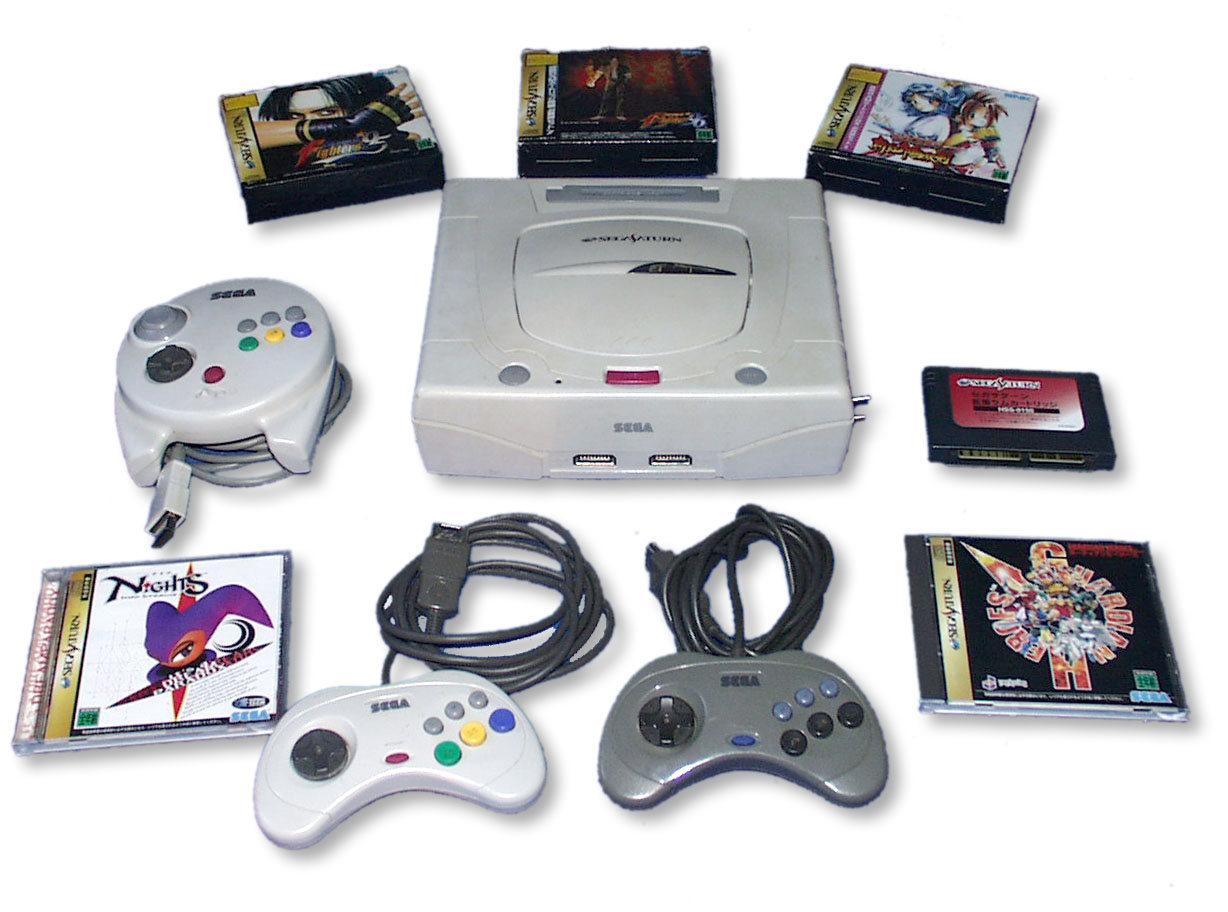
There was inexplicable stuff like the 32x. There was the inexcusable stuff like launching the Saturn the day before E3 1995 under the assumption the PSOne was going to launch at a similar price point (Sega's New Sku was over $100 dollars more, in '95 monies, and who wanted to pay $400 to play a janky Virtua Fighter?). There was the uncannily awful and superfluous stuff, like the very existence of the US Saturn pad. There was that horrendous Virtua Fighter port at launch - a port so bad the 32X was the platform to own for console VF play. Weird parallel: the Dreamcast's most disappointing launch title was also a Virtua Fighter, the 3rd one, a port that Genki had 5 months to program without retail dev kits. There was Three Dirty Dwarves -- oh, God, Three Dirty Dwarves. There was the hassle of buying all the worthwhile Saturn software from DieHard GameFan magazine if you were importing stuff like that back in the day [2]. Games like: Radiant Silvergun; Sakura Taisen; Baroque; DonPachi and DoDonPachi; Lunacy; Liquid Kids; Darius II; SteamGear Mash.

Worst of all, there was the quick, awful death of the Dreamcast.


However, in spite of it all, it must be said: from 1996-2000, Sega's various internal development houses produced more innovative, influential, quirky, and otherwise important ideas for what games can be than any other first party publisher. Right before SEGA went supernova and discovered what happens on the other side of a black hole (you become a pretty awful 3rd party publisher beholden to paccincho mavens Sammy, it turns out) they shone as bright as imaginable. Why, in the history of all first party publishers, that 1996-2000 Sega run may have had the best run, ever!

"Hrmpf!", you say, "what about beloved Nintendo?" My counter-argument is this: Nintendo's greatest run was 1985-1991, when they had a complete monopoly on the videogame market. Despite making so many epochal, titanic breakthroughs in, well, everything, Nintendo had, like, broken federal anti-trust laws and were kind of evil, forcing their licensees to release no more than 5 games a year, for which these third parties deposited huge, non-refundable monies on their "Game Pak" orders. When would these extremely expensive products reach consumer's hands? Well, it would kinda depend on when and how Nintedo felt like paying their ship captain to lug the things across the Pacific. So, imagine you're a third party publisher, publishing in America. Your company is named Qix Panic! You've been subjected to months-long waits between ordering anew second run of, I don't know, Qix, and discovering, three months later, a stack of Qix in Wal*Greens. Sadly, you see these wonderful stacks of your game two months too late; your publishing company folded; the up-front costs to produce these Game Paks were so exorbitant, so high and nonrefundable, and with no income from Qix sales in the last few months, your third party publisher had to fold up shop.

You later go on to invent Gals Panic!, so it's not all bad. But if you publish Gals Panic! for the NES, you better DAMN sure not publish it for any other competing videogame system.

Admittedly, the above is only loosely anecdotal (by which I mean, it's entirely made up), but I have been led to understand Nintendo's draconian policies and heartless money grubbing really damaged a lot of great companies. Vic Tokai sunk because of these shenanigans. Vic Tokai made Clash at Demon Head. To kill Vic Tokai, creators of one of the most awesome games ever, is as morally repugnant as sitting on a kitten until it suffocates and dies.

Nintendo then went on to do what all Japanese companies eventually do: after hitting it big with something like the Famicom, or the Game Boy, they began to crank out fabulously polished if samey sequels to their best franchises, drive that crossover appeal meme into the ground, saying things like "if it's good for the bottom line it's good for the company." This led Nintendo into trouble before, care of the Nintendo 64 -- in Japan, espically. By the time the Nintendo 64 had sunk like Too Human [3], undone by it's unwieldy "let's make this hardware explicitly to run Mario 64" architecture...

Sega was polishing off Burning Rangers, Yu Suzuki's Virtua Fighter RPG that eventually morphed into Shenmue, Panzer Dragoon Saga, Deep Fear (which, to be fair, was not that good), Fighters Megamix (stealing King of Fighters' ideas before Capcom could even dream about it) in addition to exclusive publishing deals for WARP's Real Sound, Enemy Zero, and my least favorite most favorite game of all time, D2.

What I'm saying is, the quality is higher in that early Nintendo run, but the quantity is greater in that Sega run. Weirder, too.

Back to 1996. Mario was at least helping Nintendo stay out of a black pit of financial despair -- and although the game was a revelation at the time, it was still a Mario game, which is to say, not on the forefront of what Schoenberg would call the driving force of art - "progress" - had be lived long enough to see videogames. Those incredible Am2, Sonic Team, Overworks, Smilebit and Hitmaker studios were given much more freedom to develop how they saw fit, even though Burning Rangers and Nights were less likely to make Sega money than a new Ristar game. Were I an executive at this time, I imagine I would have thought something along the lines of "why was Sonic Team -- A TEAM NAMED AFTER SONIC THE HEDGEHOG -- making an astronaut firefighting game?"


Sega's star "mascot," Sonic the Hedgehog and his good friend Jaleel White were nearly absent from the Saturn era, save Sonic R and a port of Sonic 3D Blast!, which was neither 3D nor a blast. It was clear, all the while, that Yuji Naka was not interested in recreating Sonic in three dimentions.

He disinterest was warranted - Sonic is an inherently two dimensional concept, rewarding when running in one direction, and when not, not. Although Sonic 2 had expansive stages, ferreting out secrets and exploring alternate paths though them was tedious, crippled by Sonic's exaggerated inertia and KEWL 'TUDE. Transferring that kind of purposefully sloppy mechanic into three dimensions required a more dichotomous structure similar to the game he did make, NiGHTS: Journey into Dreams.

Of course, to realize this required some game design talent, which Sega of America had very little of. Despite this, they were on the Sonic tip, passing off proof-of-concept stuff as a real game. Oh, also: more than game design talent, a new Sonic project required spending the budget for promotional CES material on promotional material for CES, instead of cocaine -- which happened (allegedly).

Oh, and if your response to that is "Sonic X-treme was actually scheduled to come out and was a real fully fledged game," I have one of Yu Suzuki's forklifts to sell you.

Sonic Team didn't need Sonic, of course, and not just because they had NiGHTs. Their bosses had one thing going for them no other platform holder could claim. Yuji Naka could throw the world's biggest hissy fit upon hearing Bandai's intentions to buy them and get that shit axed because he had a get-out-of-free card. He knew: we can fuck up as much as we want. Okawa-san's got our back.

Isao Okawa, an incredibly rich man who may or may not have worn top hats, was the CEO of Owaka-based CSK Holdings Company; they acquired a majority stake in Sega in 1984. Okawa-san acted as benefactor for Sega, singlehandedly keeping that company solvent during the rough stretches, forgiving massive debts and funding new ventures, seemingly out of the goodness of his heart and his honest belief that SEGA was doing something pretty amazing. Sega would have gone under sometime in the Master System days had Okawa-san been a reasonable businessman and cut his losses -- certainly, he would have been $700 million richer if a bunch of Americans in Hawaii decided to sell something other than coin operated entertainment devices at US Military bases [4].

Okawa is the reason the Dreamcast exists at all. Without the nearly $60 million he pumped into R&D and marketing, without his forgiving $650 million of debt, we would have no context for appreciating an orange swirl on a white background. US street date: 9/9/99 -- the best launch in the history of a videogame console, in terms of the quality and quality of titles available at launch [5]. I went home with Soul Calibur, NFL 2K, and Sonic Adventure that night, and bought Powerstone the next day -- because, for reasons I don't understand, it wasn't available anywhere on 9/9/99. We've seen a few major launches since then: PS2, Xbox, Gamecube, Nintendo DS, PSP, Xbox 360, PS3, Wii. As I remember it, they all had one good game, if that, for nearly a year after they hit streets.


Before Okawa-san finally agreed to sell his shares in SEGA to Sammy, that Yakuza-run gang of thieves, in January 2001, the Dreamcast had accumulated a library of quality games, and they did it in a fraction of the time it took the PSOne or PS2. And, thanks to the Naomi arcade board's continued popularity in the boutique shump developer world, one can still find one or two new Dreamcast games coming out every year in ridiculously limited print runs -- GuRev and Cave shooters are usually worth checking out, too, if you're feeling like spending up to $300 dollars on a Dreamcast shump.

HACKNEYED LIST OF 9 DREAMCAST GAMES YOU SHOULD ACKNOWLEDGE

9.) Zombie Revenge


This is the story of the game, quoted verbatim from the manual:

The time is the present. A city has been suddenly filled with the souls of the dead. A GOVERNMENT TOP SECRET PLAN U.D.S., Undead Soldier. It was a top-secret plan to utilize the dead for military purposes. Just before it was ready for operation all was thrown into darkness by someone unknown. A year later the city had become the home of the dead. Three of the best AMS agents were sent in, Stick Breitling, Linda Rotta and Rikiya Busujima. They have now been sent out to eliminate the enemy and track down the mysterious leader of this attack, known only as "Zed".


Aside: I could have saved a lot of time transcribing that text had I looked at Wikipedia before booting up the game.

Zombie Revenge is, like, the single best Double Dragon clone of all time, if we omit Double Dragon clones from contention that are, you know, actually good. It's a simplistic, purposefully slow-moving, gory brawler set in the loosely defined House of the Dead universe, memorably captured in Uwe Boll's House of the Dead film [6]. The collision detection is wonderfully, beautifully erratic. You fight the alien from Predator for no reason.

The only thing that could make it better is three player simultaneous co-op, which it really should have!

Okay, the game isn't great or anything, but I had more dumb fun with this than with Rockstar's abysmal State of Emergency. In fact, prior to apparently enjoyable XBLA game Castle Crashers, this may have been the last brawler worth something.

8.) Mr. Driller


Namco's other arcade-to-home conversion for the Dreamcast, Mr. Driller was conceived as a Dig-Dug sequel before someone wisely re-branded it with an incredibly filthy sounding name. As you can likely surmise from the screenshot, it's a bit like Dig-Dug crossed with a Puzzle Fighter-esque color matching mechanic. Your goal is to drill as deeply as possible though real countries until they can't be drilled no more before cute little Mr. Driller runs out of air and adorably dies. Also: don't get hit by falling blocks.

It's a fun, mechanically tight game right there, but my God would it be boring if the only obstacles were only basic, color-matching blocks. You match four, you hit the floor of your tunnel, you go do something better with your life. Luckily, I don't have to imagine a world where Mr. Driller is boring, because three atypical blocks are out there in the tunnels: white blocks, crystal blocks, and X blocks. White blocks don't match with anything, which is why they are the most obvious and annoying piece of garbage in the entire game. Crystal blocks exist in this temporal realm for a few seconds before disappearing into the ether, dropping whatever lode they were bearing before their strange unreality. X blocks take a fuck ton of time to drill though and cost precious oxygen to dispatch, requiring one to use foresight and a bit of a gambling streak to tackle.

Now, what elevates this puzzle game from "pretty good," to "umissable" is the music. I'm not positive, but I'm willing to wager the Katamari Damachy composer wrote the vaguely vaudeville, vaguely jazzy, vaguely hymnal (there's a chorus of children, even -- maybe they assumed that, like Gamera, Mr. Driller gains strength from the singing of children), vaguely completely fucking awesome score.

7.) Rez


It's difficult to write about Rez now, following so many pretentious message board posts and supercilious wankery. Like, imagine if you were at a house party, hanging out on the deck. As your friend passes by you to enter the house, you say a passing comment about, oh, Bob Dylan. Out of nowhere, some random skinny dude comes flying in and begins to harangue you for dozens of minutes about how, like, Blonde on Blonde changed his life from the first second he heard it and how Dylan's just it, man, while constantly asking to bum about four dozen Parliament Lights from you.

I don't want to be that guy, only over the internet and talking about games. There are plenty of other places out there, if that's what you want to read.

I will say, however, that Rez was United Games Artists best game by a country mile - and I love Sega Rally! - ,that Tetsuya Mizuguchi was (and is) amongst the giants in the Japanese development community, and pretty much everyone should give Rez a fair chance before launching your macro that denotes every reason the game is overrated.

6.) Super Magnetic Neo!


Platformers are at the same point today that classic, point-n-click adventure games were at 7 years ago. They're dead. Maybe one comes out every year. Dave Halverson, longtime EiC of GameFan, Game Revolution, and Play magazines, had to leave editorial earlier this year; I assume the man who gave Bug! for the Sega Saturn a 98% couldn't handle working on a magazine without googly-eyed characters.

As I discussed earlier in this now very long post, there's a good reason why the genre is mostly dead -- it just doesn't work so hot in 3D. There is a pretty decent solution to making a 3D platformer, which requires the developers to confine all the action to a single track. The first Crash Bandicoot game is an example of this.

So we'll call Super Magnetic Neo! a Crash Bandicoot-like. There are stages where you guide Neo foward, and stages where you guide Neo sideways. It's incredibly sugary, filled with pastels and bouncy J-pop music, telling Asinine Platformer Form Story #4: Evil Broken Amusement Park.

Oh, also: it's hard. Like, scary hard in places.

But, as the title Super Magnetic Neo would indicate, there's a (fairly obvious but still awesome) twist!

Neo has the ability to create a magnetic field with either a positive or negative electrical charge. These work like science intended them to: opposite charges attract, similar charges repel. It's an easy concept to get your head around, which is good, because there are many many (many) moments wherein Neo is tasked to change polarity, oh, say, 40128 times in a matter of seconds to avoid falling to his death.

It's a bit masochistic, but it's also a lot of fun, in that incredulous way platformers are. Just missing the edge on a jump is a bit frustrating, but it is also incredibly addicting, and Neo balanced these successes and near misses to a satisfying degree. There are those Zen-like moments where your fingers press buttons before you tell them to, and there are enough of them to make this an acknowledgeable Dreamcast game.

5.) Shenmue


Shenmue is a lot of things, but above all else, Shenmue is a lot of things related to drawers.

There are literally hundreds of drawers available for your enjoyment in Shenmue's eerily detailed Yokosuka, Japan. Find them in your house. Find them in one of the local restaurants. Find them in the Mah Jong parlor. You say no one would put a cabinet in a bar frequented by rowdy sailors, notorious throughout the Pacific for their anti-storage prejudice ? You best check yourself, son.

You can open a huge percentage of these drawers once you find them. After you open the drawers, you can look inside of them. Sometimes they are empty. Sometimes they are filled with inessential brick-a-brack. In very rare circumstances, there is something of value to take from inside one of them. You can close the drawers, too, but sometimes, you don't have to close them. But you really should; it's rude not to.

Compare the obsessive attention in Shenmue to its near contemporary, Grand Theft Auto III. In Shenmue, one is stuck by the lavishness attended to every wall texture, every sign, every door, every strand of hair in the game. All of this incidental material came at great monetary cost and had little genuine use to the plot or the central play mechanics. Most gamers -- those expecting to play a game with murder and kung fu -- were bored out of their minds upon discovering a game centered around wandering though a little coastal town, casually collecting information and Space Harrier high scores, driving the occasional forklift, and occasionally fighting random thuggish dudes. They wanted something like GTA III, something with lots of mayhem. Never mind almost all of those superfluous things like empty drawers -- the things that give context and soul to a game -- are absent. In GTA III there's not even an attempt to create verisimilitude; Liberty City is a dull, dead, grey videogame environment. Yokosuka is a goddman city in Shenmue, and bully for it.

Both games come with different approaches towards the same ends. Here's a place, they tell us - go play around in it. One proved to be incredibly successful. The other pretty much doomed it's publisher. I wonder if games would be radically different today if Shenmue succeeded and Grand Theft Auto III tanked. Would "sandbox" games focus less on instant gratification and stupid violence masquerading as freedom if there was a different, more contemplative, more detailed trillion seller to emulate? (Protip: no, they wouldn't. Most people think the more interesting one is boring.)

Also: I kinda like Quick Time Events, when they're implemented properly. Don't understand all the hate I read about 'em.

4.) D2


It's a Kenji Eno game.

3.) Jet Grind Radio


Smilebit's greatest moment, Jet Grind Radio is like the perfect encapsulation of what it meant to be designed by Sega's in-house development teams during the Dreamcast era. The completely unique, internally consistent visual style, complemented by flawlessly planned sound effects and music [7]? Check. The quirky, completely unique gameplay? Check. The intuitive, slightly loose way the game controlled? Check. The unforgettable character design? Check. A little bit of pandering to desirable marketing demographics? Check.

What even is Jet Grind Radio? How would you pitch this game to a marketing executive?
"Well, it's kind of a roller blading game..."

"Great! Can we get one of Tony Hawk's friends on the cover? The kids, they love Tony Hawk!"

"Um, not really, because you're trying to spray paint graffiti messages, hoping to overthrow these other graffiti gangs..."

"Graffiti you say? What's Mark Ecco doing right now? Can we put that rhino logo of his on the cover?"

"You see, we're using this revolutionary new rendering technology called 'cel-shading,' to make the graphics stand out from the competition. It takes 3D rendered objects and turns them all... cartoony, sir. I don't think Mark Ecco wants his retarded rhino screwed with in any way..."

"Cartoons, you say?!? The kids love cartoons from Japan, today! We have graphs that prove it! And you'll never guess what the most popular cartoon in the multiverse right now is -- why, I doubt they've even made an extreme sports graffiti gang war tech demo game out of this property yet! Get me the name of the company that owns those PokeMans rights, and get it to me quick! I've got a coke party to attend! It's gold, I tells ya, gold!"

2.) Skies of Arcadia/Eternal Arcadia


Earlier this year, someone at Sammy must have paused while counting their Yakuza blood money to remember their company still employed one of the greatest scenario designers and RPG developers in history. Maybe he entered some long-fogotten conference room and saw this employee, one Rieko Kodama, eating ramen noodles in the corner and realized "oh yeah, this person made those Phantasy Star and Eternal Arcadia games, maybe we should get her working on something people will actually enjoy, instead of a fucking Altered Beast game for the PS2?!"

I'm a little bitter it's been 8 years between Skies of Arcadia and Valkyria Chronicles, but really? A fucking PS2 Altered Beast game is the best work you can offer this wonderful human?

This wonderful human knows how to create visually compelling worlds and she does this when planning Eternal Arcadia. Skies has the same bubbly, effervescent art design of her Phantasy Star games, replacing all the 80's pop utopianism featured in PSII and IV with brightly re-imagined Age of Exploration stylings. To complement this lovely world, she creates lovely people. Countering the late 90's trend installing mopey teenagers with emo bangs and outfits covered with zippers into the main character, Skies of Arcadia is populated by likable, optimistic protagonists: Aika, Vyse, Fina, Enrique, and especially the duo of Glider and Clara are thousands of times more interesting than another stoic amnesiac in desperate need of a lay.

Her first two tasks satisfactorily tackled, Kodama decides to spin a neat little yarn to occupy her bubbly heros and their effervescent world. It is a good, solid story, entertaining without straying far from the RPG template. And if much of the plot has been co-opted wholesale from Myazaki's Nauscaa and the Valley of the Wind, well - one could chose something worse to rip off.

With that out of the way, Kodama-sama needs to implement the gameplay system, one strong enough to tie everything awesome she's thought of together. Luckily, she knows a lot of people with a talent for doing just that - Overworks! She's one of the project leads there, after all.

Overworks may have a surfeit of ideas to shove into a new RPG, but Eternal Arcadia wasn't the place for 'em. Nothing in the game was done for flash or effect in and of itself: outside the 3D engine and seizure-inducing lighting effects, one could hardly tell that six years past between PSIV and Skies. No flashy CG. No voice acting. No cutting back on the random encounters. No simple, linear dungeons. Even in the staid JRPG genre, where innovation and change creep along with the rapidity of tectonic drift, Skies takes only one risk - but it's a pretty big risk, and the result is awesome fun. But we'll get to those ship-to-ship combat bits in a moment. They'll still be shit hot when we get there.

The usual random encounters are traditional, but fun. Exploring the skies and the dungeons of Arcadia is dangerous business. It is also just a little more tedious than murdering dangerous things ought to be. Adventuring requires a few run-ins with some jerk ass monsters, many of whom look like sperm cells wearing hula hoop belts. All who invade are subjected to turn-based tussles until one side is slaughtered completely. It usually takes just a little longer to finish a combat encounter than I'd like in Eternal Arcadia; I prefer the DraQue style (God, you can tell I'm tired if I'm using Japanese nicknames for videogame series), which has always relied on text to convey the action during fights, letting one play at a very zippy pace. After a few dozen leaden "attack, attack, attack, heal" sequences with Skies of Arcadia's party combat, wherein every action requires you to watch as your characters slowly position themselves on the battlefield in completely arbitrary ways before doing what you fucking told them to, you really want zippy, text-heavy fights.

Kodama and Overworks should do something about those slow battles, but some of her creative juice is harnessed to develop another gameplay system, one unlike any other RPG I can think of at the moment, and one I hope to see again in some form again: ship combat. Kodama recalls her childhood living in Kanagawa prefecture, between Mt. Fuji and the sea, and from this intuits the nature of naval combat is vastly more complicated and slower-paced than the traditional RPG combat she is more familiar with. Instead of copying an existing system from a competing RPG or grafting a dopey action game in the bigger set piece battles, Kodama realizes with a start that one could be true to both the strategy and forethought required in successful naval combat and to the conventions of the JRPG genre.

This is her idea: instead of a typical "you take your turn and I take my turn and I'll gut you before you gut me" turn based combat, why not string four turns into one input period? One must think not only of his current status and weaponry, but also the foe's status, and how the foe's actions in the future will impact one's ship and one's decisions made now! GENIUS!

And the number one Dreamcast game you should acknowledge is...
stay tuned to find out in the future!


footnote 1: If they ever decide to bring Ryu ga Gotoku Kenzan! in the US -- and considering the relative lack of Edo period samurai epics exlcusive to PS3 (or many other 3rd party exclusives, for that matter) I see no reason why not -- I have to wonder: what are they going to call it? Yakuza: Before Such a Thing Existed? Yakuza: Birth of the Return of the Yakuza?

footnote 2: I did not do this. I have owned one Saturn, which I bought from a guy in high school I was friendly with, Chase. This is around... 2000, I guess - after the Dreamcast launched, for serious. I think it worked for 2 months after I bought it, he refused to refund any of the money I paid him (which, admittedly, wasn't very much) and we didn't talk too much after that. He wasn't a bad guy -- he just liked Lincoln Park too much, and I'm pretty sure he got into drugs around the same time he sold me the Saturn.

footnote 3: In the sense that neither sold SUPER well, both had some pretty bold ambitions, and neither quite understood the unfair and vicious nature of their consumer base. Well, Dyack might have, simply because he's read books about middle management and somehow took that information and formulated an insane and nonsensical argument about it in the month before Too Human's release. This was a specious simile

footnote 4: While that was a silly sentence, I just want to make clear that Sega was started by four dudes in Hawaii to sell coin-op machines in American military bases. Stuff like vending machines, ticket meters, and amusement devices.

footnote 5: It's unlikely to be surpassed nowadays. In the year between the Japanese launch of the Dreamcast and the American launch, developers, no longer saddled with non-retail development hardware and zero experience developing stuff for a new platform, were able to craft real games instead of up-rezed ports or tech demos. Now that all the platform holders release their shit hot new toys nearly simultaneously in United States, Japan, and Europe, we all have to suffer though fucking Red Steel and Kameo. It was great when only Japan had to deal with that nonsense.

footnote 6: Gabbi and I went to see Mount Eerie at Lewis & Clark quite a few years ago. I had no idea what to expect, having heard no reports of Phil Elverum's live shows, although I assumed he didn't attempt to recreate the records onstage. He came onstage after Thanksgiving and nervously opened a brief, friendly Q & A session with the audience before playing any music. Someone asked him what Anacortes, WA is like."Oh, it's pretty nice when they aren't filming zombie movies there," he said. Apparently, that was where Uwe Boll's House of the Dead "movie" was shot. He went on to explain that he decided to start filming his own zombie film as close to the set of "HOTD" as possible, in protest, and can actually be seen very briefly in the movie, wearing his zombie makeup, which was just the word "ZOMBIE!" written in Sharpie across his forehead.

footnote 7: At least in Jet Set Radio, the Japanese version of this game. American gamers were treated to a different soundtrack with licensed songs, which were unfortunately chosen during that horrible era when every game had the song "Dragula" in it somewhere.