8.14.2008

Sorry for the delay in the "X Days an Article 'bout Yahtzee's adventure games," but as far as I know Jackie is the only person who reads this blog anyway. :

So the incredibly niche article about 4 year old independent adventure games is going to have to wait a little longer because a few days ago THIS happened:


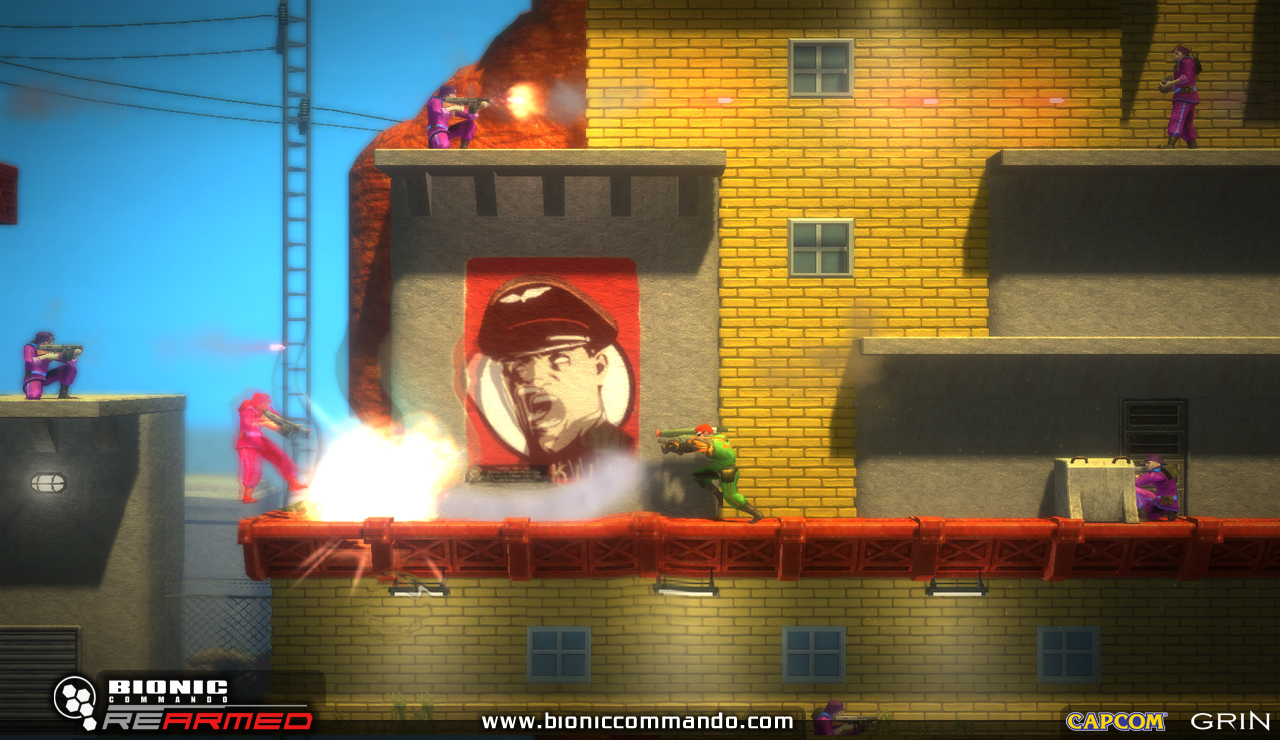
Yes, I've played the demo of motherfucking Bionic Commando ReArmed about 40 times since it's release. Is that right? Bionic Commando ReArmed... I think it's inter-caped. That is usually a major detriment to success, because very few things are cool enough to be inter-caped; Bionic Commando is one of the few.

At some point I''ll need to get some PSN voucher cards for which to pay Capcom, GRiN, and most importantly Ben Judd.

ALSO while foolishly trying to organize the closet underneath my staircase, I came across a large cache of long-missing NES games. There's still quite a few missing from the overall collection (where's DynoWarz, for example? And do I really want it?) but I feel much more whole now.

Next, I have to track down some of my SNES games, because the only ones avalible to me right now are things like "Killer Instinct and the Mortal Kombat games. Where are those Quintet games I bought? What kind of library is complete without Actraiser, Soulblazer & Illusion of Gaia?

Speaking of Actraiser, I played it for about 2 hours last weekend because Jeremy Parish commanded me to; while it hasn't aged as gracefully as other near-launch SNES games like Super Castlevaina and Super Ghouls 'n Ghosts, I really enjoyed it. I wish the side-scrolling bits were just the arcade Rastan, though, because they're clearly going for that Rastan feel, only screwing it up.

Off to get coffee with Jon now; hopefully I'll be back later.

The Yahtzee Mythos: 1 Day an Introduction

Ben "Yatzee" Cronshaw is a name that, by now, you are likely familiar with. Every Wednesday he publishes a new installment of Zero Punctuation on the increasingly pretentious and turgid but still excellent Escapist website. What Zero Punctuation does is pretty common internet fare -- video reviews, breathlessly delivered by an Englishman-by-way-of-Australia just seething with contempt at all the dumb and predictable things developers continue to shove in their games, complemented by incredibly crude drawings of horrific violence and phalluses -- but unlike most videogame-related humor things, it's astonishingly funny and has garnered a lot of acclaim from the sort of people who acclaim these sorts of things. The primary audience for Zero Punctuation are message board readers and blog commentary writers, the kind of enthusiast blindly loyal to one gigantic monolithic corporation or another - corporations, it should be noted, that care not one whit about their fanboys, so long as money keeps flowing into their coffers -but the humor isn't so niche as to be unintelligible to the lay-person. The humor must have some broad appeal: although they should hate his guts, partisan fanboy-types still flock to Zero Punctuation to watch Yatzee express his universal disdain for their favorite franchises.

Every major videogame blog has caught onto this. The Kotakus and Joystiqs of the world embed the newest episode of Zero Punctuation in blog entries and post that shiznat the second it goes live; far easier to generate those all important ad-revenue generating clicks by repurposing other people's content than it is to write compelling things themselves, I bet! Heh.

It's possible that the like four people who read my blog haven't seen Zero Punctuation yet, however, so I'm going to take a page from the real bloggers and repurpose Yatzee's content right now. After all, I barely write anything, let alone anything compelling! I gotta find a way to generate those clicks, get that ad revenue up, maybe get some ads, make a living off of this... anyway, here's a review of Army of Two:


Eh? Eh?

Well, I still think it's hilarious.

Before Mr. Cronshaw achieved his current level of notoriety, however, he was famous among an even more niche and dorky group of people than Escapist readers -- amateur/indie adventure game scenesters.

A few years ago, Yahtzee created a few random series of games using the Adventure Game Studio (AGS). His first brush with success came when the "Rob Blanc Trilogy," a series of comedy games I'm never going to play because all the graphics were created in MS Paint. Fuck that. I assume they were funny, or at least not egregiously not funny. That's not what I want to talk about, though. I want to talk about Cronshaw's ambitious series of horror games, formally entitled the Chzo Mythos: 5 Days a Stranger; 7 Days a Skeptic; Trilby's Notes; and 6 Days a Sacrifice, because I've played them, all of them, to completion (mostly)!

I fully expected to hate the games, because they're adventure games, and divorced from the syrupy taint of nostalgia, adventure games are a tough sell. Shakespeare was one of the first to denounce these things, memorably writing "An Al Lowe game is a tale told by an idiot, full of sound and fury, signifying nothing." The vast majority of indie adventure game developers are kids who grew up playing Sierra & LucasArts games, where psychologically profiling Roberta Williams or Ron Gilbert was kinda the only way to solve puzzles. In other words, people almost exactly like me, but delusional.

So one must temper enthusiasm when admiring the hefty shelf of virtual awards the AGS community has awarded the Chzo Mythos. Seriously, the AGS community is pretty excited whenever a game doesn't use any of the five pieces of clip art present in every other AGS game on the market. One of the major selling points of 5 Days a Stranger is that Yahtzee did all the art himself, in Photoshop. All the animations, too. Almost no one who makes these little games even bothers to do that. When a community embraces and loves a game because someone bothered to create their own artwork for it, that tells you something. Not that every AGS game I've played is bad -- quite the opposite! -- but some of the better ones are not free and therefore dead to the AGS diehards. I can't understand how upsetting it must be, discovering a developer with the audacity to charge a couple bucks for their really well-done, incredibly interesting rabbinical adventure of mourning and mystery, but that's just the culture we live in today. As we've just seen with Braid, $5 can seem like a staggering amount of money to the sort of dude that bought Halo 3 with the cat helmet.

Before I even started playing any of Yahtzee's oeuvre, I toyed around with a "Zero Punctuation"-style takedown of these little freeware adventure games, only with ponderously slow narration and images of polar bears and walruses maniacally spinning like Spyrographs instead of comedy drawings on yellow backdrops. That'd show Yahtzee how it feels to have someone's hard work demolished in 2 minutes!

However, I dropped that elaborate and not particularly clever plan: firstly, by coming to terms with my own enormous limitations as a voice actor and animator, and secondly, after enjoying 5 Days a Stranger quite a bit. It is evident that Yahtzee has some understanding of game design, which ads some weight to his critiques, and because of this his acerbic ranting on the failings of other games are more than just disposable fun; they are rough sketches of a wise man's brain that hint at the things Yahtzee might want to put in a "real" game if given the time and resources.

Coming in the near future -- like, later today hopefully -- a look at 5 DAYS A STRANGER & 7 DAYS A SKEPTIC
7.23.2008

Fake Looking World, But With Actual Death

After reading this article in Slate, I felt an awful chill run though my body.

A brief summary: Raytheon, a military contractor, believed the current technology utilized in unmanned aerial vehicles like the Predator drone needed improvement. The machines were cumbersome to control, and pilots can only see what the UAV's camera can see.

Raytheon hired game developers to create a "Universal Control System," which debuted in Britain last week. From the Will Saletan piece:
The most important upgrade is visual. Multiple wide-screen monitors wrap around the pilot, producing a 120-degree field of vision. They integrate actual video from the drone with an interactive digital replica of the surrounding buildings and terrain. By digitizing the picture, UCS can lay information over it, displaying your available weapons and the location of nearby troops.


In other words, the Universal Control System creates a something that looks alarming similar to a videogame on the fly using real world data. It's like Tom Clancy Air War HAWX, but with real bombs and real death.

Look, it's one thing for the Army to distribute America's Army as a recruitment tool. If you're gullible enough to join the armed services because a couple really kickass Capture the Flag multiplayer sessions made you realize how fun and easy war can be, don't let me stop you. We need brave soldiers like that as far away from me as possible.

Making real war more like videogames, though? Modern combat is already top heavy with depersonalizing technological innovations, but at least someone has to look though a real television monitor at real objects before inputing the commands necessary to obliterate them. A videogame interface is exponentially abstracted from that abstraction; the reason "it's only a game," has been used to defend all sorts of morally repugnant behavior present in the medium is that it really is only is a game. It's not real and it can't hurt you physically or turn you into a murderous psychopath. There are consequences to gaming, both positive and negative, but until now they've been banal negative consequences -- 31 year old virgins with fourteen level 70 WOW characters, dudes flunking out of college because Xenosaga came out and needed to be played to completion finals week (true story: happened to a dorm-mate of mine), that kind of thing.

Of course, this being a mainstream media piece, the dangers of digital entertainment are exploited; Saletan makes it sound like the next generation of American soldiers, weaned on Playstion, are so disengaged from reality that murdering someone via this Universal Control System, to our brave men and women in armed services, will feel just like unlocking an Xbox achievement. Well, he doesn't say that. He compares the experience to setting high scores in arcades -- unaware that high scores and arcades have been dead for at least 8 years now, in the US.

However, this fact remains: war should not be a game. It should not look like a game or reward your achievements like a game. Taking a human life is serious business and it should be treated as such. It'd be nice if our political leaders knew this; perhaps funding to abuse the possibilities of the gaming medium will dry up when the era of the Military-Industrial Complex finally comes to an end.

Not every military application of videogaming is a grotesque misappropriation of technology, however. Have a look at a recent New Yorker article by Sue Halpern on a new PTSD treatment that incorporates a modified version of Full Spectrum Warrior. Here's a video.

7.22.2008

MULTIPOINTS

Some thoughts:

OBLIGATORY HARDCORE GAMER POST E3 Wii COMPLAINT
*I am personally offended that UbiSoft, Activision, and other publishers have chosen to start "boutique" labels catering to a booming new demographic of gamers: stupid people. Already, this demographic has a politically correct title ("casual gamers"), a proclivity for game boxes with family-friendly pastel colors everywhere, and enough copies of Carnival Games to drown like fifteen kitties. And have you ever tried to drown a fluffy, cute little kitty with hundreds of flexible plastic discs? It's hard.

The Wii has not performed as it should have, that is to say, poorly. The system should have at best sold moderately well, mostly to the Nintendo fanboys, who'll buy anything Hudson designs so long as "Nintendo," is slapped prominently on the side of the plastic.

There were potential benefits to this "new-gen" arrangement: Nintendo had an opportunity to become the place developers, slaving away under the auspices of genocidal tyrant companies like EA's and Activision, could stretch their creativity,. While development costs continue to grow at an alarming rate for the HD systems, ensuring a steady stream of Bald Space Marine shooters and sports games to keep the corporate coffers filled, the cost of doing an experimental little thing on Nintendo's strange white box promised to cost next to nothing. And that WiiMote looked so elegant, in stark contrast to the increasingly ridiculous Xbox & Playstation harness-shaped contraptions -- perhaps those financial and input limitations were just the thing to spark some innovative ideas, eh?

*PFFFFFFFFFFFFFFFPHT*

As consolation, PSN and the Xbox Live Arcade have gamely stepped it up, providing the kinds of experiences I assumed the Wii would deliver.

The Wii, which should be overflowing with unrealized, epoch-making masterpieces 18 months into it's life-cycle, is today the home of... Ninjabread Man.

And the companies I assumed would throw their creative-types a little freedom to tinker around with gameplay mechanics, narrative presentation, waggle control, and the rest? They secured as many multi-year deals with Hanna Montana as their lawyers let them.

Outside of MadWorld, can you name one high profile Wii game developed by someone living outside of Kyoto?

I PLAY SOME HALO 3 CO-OP AND DON'T HATE IT
*I finally get why Halo is such a monster seller, and it only took me 7 years to understand: game's just dialed in. So far, it is the only console FPS I understand how to control -- the slow, smooth nature of the combat and the tuned analog stick sensitivity are as compatible as peanut butter & chocolate.

Other things I discovered:
*There are a lot of lasers and energy balls and other such nonsense. In a sci-fi shooter, this is par for course. However, Bungie is the only developer that understands that spectral highlighting and particle effects work most effectively when employed with subtlety. Unlike, say, the Metroid Prime series, firing a gun does not fill the screen with light bloom. The brilliance of underselling the flashy graphical effects is that, for once, you can actually see what you're shooting at.

*The shooter genre consists of the same 30 seconds of gameplay repeated over and over again: Move forward - see enemy - shoot enemy - duck behind something - kill enemy - move forward. Bungie gets this, and makes sure those 30 seconds are a lot of fun.

*I can't imagine playing this game solo. Co-op is what made the game fun.


I BEAT METAL GEAR SOLID 4 ONLY TO DISCOVER I LIKED IT LESS THAN METAL GEAR SOLID 3


*I might have more to say about this game later, but the most striking observation I have is as follows: Kojima needs to hire a goddamn editor.

7.17.2008

COLUMN: 'Jumping Really, Really High': There's Only One Way to Go: Up!


['Jumping Really, Really High' is a semi-annual column by professional jumping enthusiast The Dude From the Legend of Kage - pronounced "KAH-GAY" - the protagonist in Taito's seminal arcade and NES title Legend of Kage. In this installment, Dude From Kage comments on the recent innovations in super huge jumping on display at E3 and dispenses some advice for newcomers to the genre.]

The humble jump is a most basic action to perform in a videogame. For many players of games, older ones in particular, jumping is the action performed more often than any other, if we were to add every single jump ever attempted together. That is to say, you've jumped over more things than you have shot with guns, ducked under, punched, hit with sword, and so on in your gaming career.

There is a sensible reason for this. In 2D space, which I have spent my entire career occupying, the jump is the most elegant solution to many design problems creators and players face. Although you in the 3D space may not spend your days jumping constantly to avoid obstacles, you have a major ability unavailable to me - lateral movement. When confronted with a pit in real life, you can just step around it or find an alternate path to your destination. Ninjas and wizards are more difficult to circumvent, but if you attack the problem with patience and dedication, there is nothing those fiends can do to you. I envy this.

What works in real life does not always translate well to your 3D games, of course. The potential for getting lost is a real worry in 3D, and the confusing wireframe maps and tiresome need to control the camera must make finding destinations difficult! I am lucky insofar as my destination is always hundreds of feet to my left or thousands of feet above that river in the second stage. Those ninjas must have taken my gal in one of those two directions; there's no other place for me to go.

In addition, your 3D games are dauntingly complicated. Your playstation or Xbox controller has 8-16 buttons (depending on how the D-pad is utilized) and two analog sticks. Many contemporary games require you to use all of these buttons to do anything neat. Two buttons for my throwing star and sword attacks and a working d-pad to jump 90 feet into the air -- that was all The Legend of Kage needed to be fun. Okay, it could have used tighter controls. Any level design wouldn't have hurt. Otherwise, though -- perfect.

However, videogames are in three dimensions today, with obvious and awesome exceptions like The Legend of Kage 2 - coming to America soon on your DS! This shift briefly put a damper on the jump, because in realistic 3D space, one in which objects appear to have depth and weight, things could look very silly and cheap if no laws of physics get obeyed.

As the main hero in the Legend of Kage, however, the humble jump was merely a starting point. After all, I could uncontrollably leap like 90 feet into the air, throwing ninja stars in 8 directions, limbs akimbo. Indeed, my jumping was truly a marvelous thing to behold.

I am ashamed to admit that I grew cocky in the past 15 years, certain that my record for "most ridiculous jump height" was safe forever. Until 2007, my closest competition was Mighty Bomb Jack, but his crippling addiction to eating things he found on the floor of a castle shattered his hops, his health, and his dreams.

However, in the wake of Crackdown's massive success, a whole slew of 3D superhero games is 'acoming this way: Prototype; Infamous; Spiderman Friend or Foe; Mirror's Edge (sorta) and I'm sure a lot of other dumb games I haven't heard of yet -- games with big jumps.

As an expert in the field of jumping, I have some advice for the developers of these types of games:

  • IMPRECISE CONTROL TO ENHANCE VERISIMILITUDE - So you know when you jump off, like, a tree branch forty feet up in the air in The Legend of Kage you have absolutely no way to gauge your landing spot? Definitely keep that mechanic in your 3D games. That's what makes it cool.
  • DESIGN LARGE, ARBITRARY ENVIRONMENTS TO TRAVERSE - Don't worry if the layouts don't make any sense -- force players to move in unintuitive ways. They'll love you for it!
  • WORTHLESS SWORDS - What kind of jumping game would empower the player with something like a useful melee attack? A jumping game with no balls, that's what.
  • EPIC CINEMAS - The Legend of Kage was one of the first Nintendo games to open with a cinema. In it, my girlfriend or mother or sister or whatever gets kidnapped by an evil blue ninja. There's no dialog. There doesn't need to be. Remember: whoever plays your games is going to want motivation and production values.
  • PUT SOME AWESOME KABUKI WIZARDS SOMEWHERE - Those things were awesome.
Listen to my advice and you're game will be remembered 23 years later. It may not be remembered fondly, but it'll be remembered.

7.14.2008

6.24.2008

Goodbye, Soulless Corporate Dope Peddlers - Hello, Temp Work!

Today, I have an appointment at a temp agency. Why did I schedule this appointment, considering that I am currently employed at the nation's largest videogame retailer? Although working retail is never much fun, does it not help to enjoy the product you sell?

Well, yes and no.

Games are cool. I would have no objection, no reason to seek outside employment, if my sole task was that of a shopkeeper, selling goods to eager individuals with genuine use for 0ur products. As anyone who has ever shopped at GameStop before knows, however, the sales associates are not only enabling monetary transactions; they're pestering you ceaselessly to spend money on preorders, warranty plans, club memberships, strategy guides, and all manner of useless ephemera. You may find this behavior obnoxious -- shut up about preorders already, you may think, I shouldn't have to preorder a game like Metal Gear Solid 4 when copies of it are about to become as rare as air molecules! -- but please understand: our jobs are entirely dependent on you purchasing this stuff. You don't sell, your hours get cut. You don't meet quota, you get reamed by your (almost always sleazy) manager.

I would field calls every day inquiring as to the trade-in value of certain games. Guess what? I was absolutely forbidden from answering that question over the phone. Why? Because if a potential customer hears what a pittance our store offers in trade-in value for a two month old game, they are far less likely to drive to the store and trade their game in. The entire business model revolves around inconveniencing the customer for our profit.

Ethical quibbles aside, it is very difficult to maintain my kind of lifestyle while working a part time job in a strip mall. "My kind of lifestyle", of course, is a misnomer -- I live with my parents and spend most of my income on games, beer, and cigarettes -- but still. I invested all my liquid capital in a PS3, limiting opportunities to socialize with other people, and right now I need to interact with humans for my own mental well being.

Hopefully, I'll get a higher paying job, full time work -- then, I will have more disposable income for games, hence a few more articles on the blog. Articles about Pocky & Rocky, the history of pirated fighting games, the PC Engine, the effect gaming can have on serious mental illness, DeJap, Metroidvainias (specifically Cave Story), and more!

I've written around 20 words in each of the above ideas for posts -- just so you know, I may only put things up a few times a month, but I'm constantly agonizing over new, equally awful posts.

Sigh.

6.20.2008

Early Metal Gear Solid 4 Impressions (Minus World Edition)

I've no idea what to make of Metal Gear Solid 4 yet -- is it an excellent, satisfying, mechanically sound experience of tactical espionage action or is it a wildly ambitious, staggeringly uneven examination of every half-developed idea Kojima drew on the back of a Ghost in the Shell trade paperback one afternoon? Can I dismiss it as a $100 million dollar vanity project with gameplay not all that radically different from a 1990 MSX2 game and this archaic approach to cut-scenes straight outta "Silliwood"?

No, no, no, a thousand times no. It's all irrelevant!

MGS4 is nearly an elegy; at a time when every game on the 360/PS3 is flashy, underwritten shooter garbage, the gutsiness, uniqueness -- straight-up Metal Gear-ness of this game is refreshing as hell.

While sometimes very frustrating to play (fuck you, tracking mission in Act II) MGS4 gets the perfect balance between stealth and action better than anyone. After I beat the game, I'll think about organizing my thoughts and posting something here. Then I probably won't do it, considering my output so far.

Random Fun Fact About My Manual Dexterity: This new, improved control scheme is much more logical and sensible, and I am sure most people will grasp the basics with ease. Most people are not me. After 8 or so hours playing, I'm still turning the wrong way all the time. When moving the camera, I need both the x and y axis inverted on the right analog stick -- which really fucks everything up as soon as I hit L1 and start aiming. It's... really weird. Dragon Quest VIII ruined intuitive right stick controls for me, or something.

Sneak Preview of Next Post


What do Pocky & Rocky & a Tiawanese pirate version of Soul Caliber have in common? STAY TUNED!